Webinar recap ·

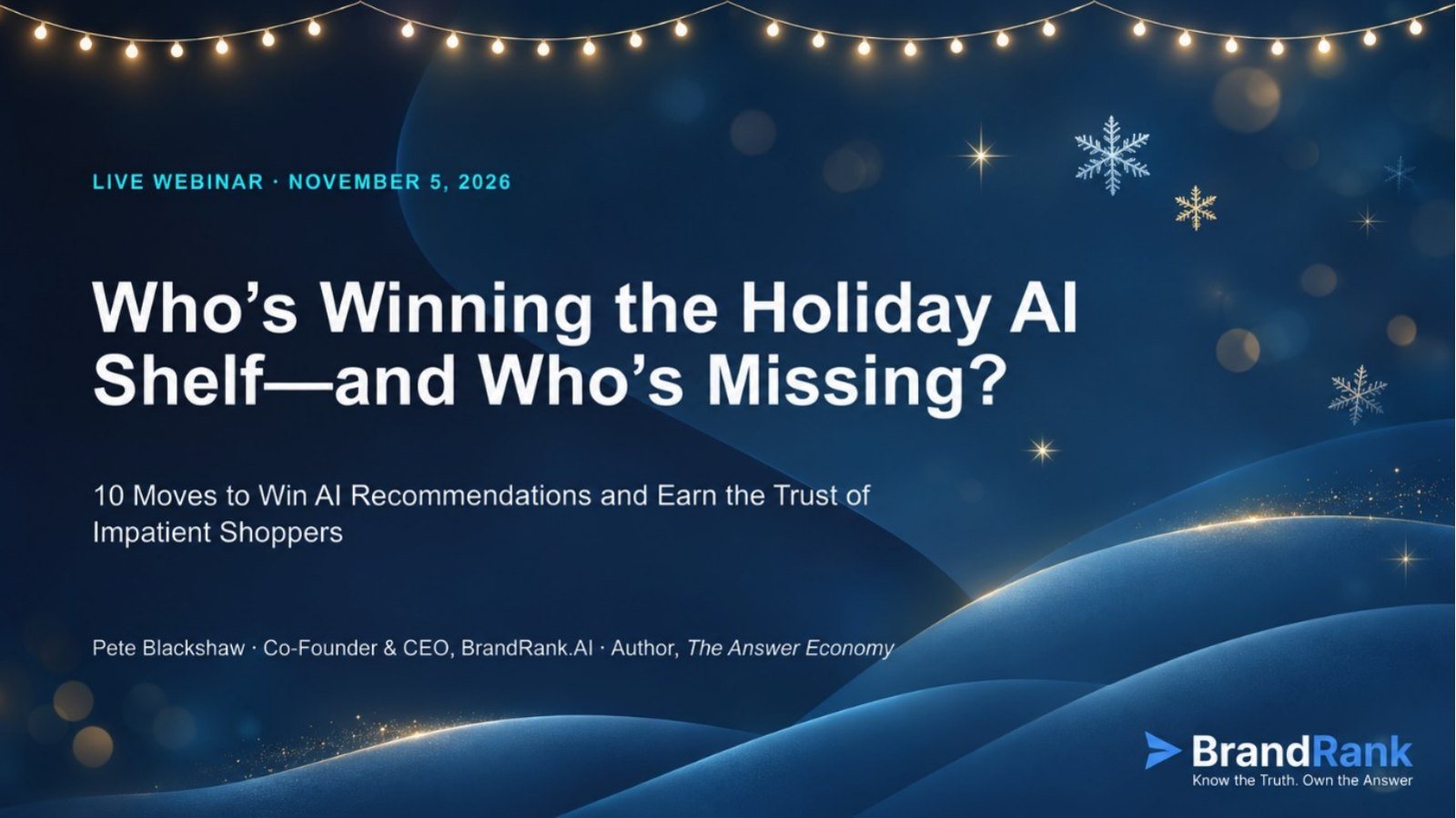
Who’s Winning the Holiday AI Shelf—and Who’s Missing?

Ten moves to win AI recommendations and earn the trust of impatient shoppers. A slide-by-slide recap of BrandRank.AI’s holiday webinar, with the research findings behind every slide and the audience Q&A.

In short: across BrandRank.AI’s holiday research, six AI assistants agreed on where to shop 65% of the time but on what to give only 31%. Amazon, Target and Nordstrom won different shopper moments, returns and service decided recommendations, and 54% of consumer-advocacy answers fully met our criteria. Ten moves help brands be found, defensible and ready.

65%vs 31%Engine agreement on where to shop vs. what to give, across six assistants
25of 48Core service answers that named Nordstrom; Amazon received one
54%Consumer-advocacy answers that fully met our criteria across 36 scenarios
5of 6Assistants whose top pre–Black Friday advice was a dated source of truth
Opening
← → keys · swipe
Part 1 of 6

Opening & Methodology

Slide 01

Welcome: The holiday AI shelf

Opening & Methodology
Original webinar slide 1 of 31 · Click to enlarge

☝ Tap the slide to enlarge it · swipe or use the buttons to move through the deck

Presenter talk track

Holiday shopping is increasingly beginning with a question: What should I buy, where should I buy it, and can I trust the answer? AI assistants are entering those decisions at exactly the moment when retailers and brands have the most at stake. Today we want to move beyond the hype and show what the assistants actually said in our holiday research.

We will walk through three connected questions: Who gets recommended? How dependable is the advice? And when a purchase goes wrong, does AI help the shopper? We will end with practical steps brands can take, including changes that are still useful during the peak holiday period.

Slide 02

Why we study AI from the consumer’s side

Opening & Methodology
Original webinar slide 2 of 31 · Click to enlarge
Presenter talk track

A quick word about my perspective. I have spent much of my career studying consumer feedback, complaints, trust, and the moments when brands either earn or lose loyalty—from P&G and global consumer relations at Nestlé to founding a consumer-feedback company, serving as National Chair of the Better Business Bureau, and writing about word of mouth and the Answer Economy.

That history shapes how we look at AI at BrandRank. Visibility is important, but it is not enough. We want to know whether an answer is accurate, fair, and helpful to the person asking. In our work, vulnerability is not just a defensive metric; it often reveals the very changes that can improve a customer's experience and make a recommendation more credible.

Slide 03

Three studies, one shopper journey

Opening & Methodology
Original webinar slide 3 of 31 · Click to enlarge
Presenter talk track

Think of one holiday shopper—let's call her Dana. She's short on time, watching her budget, and trying to find the right gift. Her journey has three moments of truth. First, an AI suggests what to buy and where to shop. Second, she decides whether the answer is credible enough to act on. Third, something may go wrong: a late delivery, a return, or a questionable transaction.

Our research follows that journey through three complementary studies: a recommendation index, a targeted stress test of the advice behind recommendations, and a consumer-advocacy assessment. These are studies of AI responses, not a survey of what every shopper actually bought. But they tell us which brands and protections the assistants are making visible—and which they overlook.

Slide 05

Why this holiday season is different

Opening & Methodology
Original webinar slide 5 of 31 · Click to enlarge
Presenter talk track

Three forces make this season different. First, AI is reaching consumers at enormous scale and moving closer to the transaction itself. Second, shoppers are under economic pressure, so value, confidence, and the ability to reverse a bad purchase become more salient. Third, asking an assistant is becoming a familiar alternative to navigating a page of search results.

The figures on the screen illustrate the scale and direction of that shift; they come from different external sources and are not all measured on the same basis. The business implication is more enduring than any one forecast: the shelf is no longer only a physical or digital merchandising placement. Part of it now lives in an answer, and brands need to understand what evidence earns them a place there.

Part 2 of 6

Recommendation Share

Slide 06

AI knows where to shop—not what to give

Recommendation Share
Original webinar slide 6 of 31 · Click to enlarge
Presenter talk track

Here is the headline from our October holiday Recommendation Share Index. Across the retailer questions we tested, the six assistants agreed on the top answer 65% of the time. Across product questions, that fell to 31%. In other words, AI showed more consensus about where to shop than about the specific gift to buy.

Ask for the best gift for mothers and six engines produce six different first choices—from an iPad to a throw, slippers, jewelry, a photo frame, or an e-reader. That is not proof that any one answer is wrong; gifting is subjective and prompt-sensitive. It does show how open this recommendation space remains. For brands, the opportunity is to provide an unmistakable reason to recommend a particular product for a particular shopper and occasion.

Slide 07

Retailer leaders own different moments

Recommendation Share
Original webinar slide 7 of 31 · Click to enlarge
Presenter talk track

The big three in this sample—Amazon, Target, and Nordstrom—accounted for 29% of the retailer answers, but they tended to win different jobs. Amazon surfaced around online convenience and speed. Target appeared when a shopper needed a store or pickup option. Nordstrom was especially prominent in questions involving confidence, service, and returns.

This is why a retailer's strategy should start with the moment it wants to own, not just its overall mention count. A brand may have broad awareness and still be underrepresented in the specific need states that matter most to its customers. The data reflects how the tested engines described these retailers, not an independent audit of their operating performance.

Slide 08

The specialists winning their aisles

Recommendation Share
Original webinar slide 8 of 31 · Click to enlarge
Presenter talk track

The second surprise is that specialist retailers can win with a narrow, clearly understood promise. Etsy shows up for distinctive gifts; Sephora and Ulta for beauty expertise. Their advantage in these tested prompts is not necessarily greater scale—it is that the assistant can connect the retailer to a particular shopping mission.

The reverse is also instructive. Walmart's reach and Costco's value reputation did not translate into leadership across every gift question we asked. That doesn't mean those businesses are weak or that the engines never recommend them. It means their strengths were not as prominent in this specific set of answers. A clear, verifiable specialty can outperform generic claims to being 'the best.'

Slide 09

Every AI engine sees a different shelf

Recommendation Share
Original webinar slide 9 of 31 · Click to enlarge
Presenter talk track

There is no single, universal AI shelf. Different assistants drew on different evidence and made different judgments on the same shopping questions. In our sample, the relative visibility of Walmart, Nordstrom, and other retailers varied meaningfully across engines. The six profiles on the slide are shorthand descriptions of observed tendencies, not fixed personalities or permanent rules.

A blended score is useful for leadership, but it can hide the engine where your customer is actually doing the research. We should evaluate answer share by engine, by shopper mission, and over time. Models and retrieval systems change frequently, so these October findings establish a baseline—not a promise about how an assistant will respond next month.

Slide 10

Recommendation stability and transparency

Recommendation Share
Original webinar slide 10 of 31 · Click to enlarge
Presenter talk track

Recommendation Share has two dimensions: how often a brand wins, and how consistently that win repeats. In some questions, the results concentrated around a familiar product, such as Meta's smart glasses or a leading phone. In categories such as electric vehicles, the answers were more dispersed. Both patterns matter. A high share that disappears with a slightly different prompt is less secure than it may look.

The second issue is transparency. We saw assistants question the credibility of commercial claims while not always making the commercial relationships around their own ecosystems clear. That is an issue to monitor, particularly as assistants become commerce platforms. We are describing what appeared in these responses, not concluding that every recommendation was influenced by ownership or advertising.

Part 3 of 6

Service, Returns & Trust

Slide 11

Service decides the season

Service, Returns & Trust
Original webinar slide 11 of 31 · Click to enlarge
Amazon · video example

Watch this example alongside the discussion of Amazon, holiday shopping and customer service. Watch on YouTube ↗

Presenter talk track

Now we move from the gift shelf to the service desk. In the service-related questions in our sample, Amazon was closely associated with preventing problems before delivery; Nordstrom was much more prominent when questions involved returns or remedies after purchase. Nordstrom received 25 of 48 core service answers, while Amazon received one.

Returns were mentioned 28 times in 72 service rationales, while AI-powered support was not credited in those explanations. That's a striking signal about what assistants cite as reassurance, not a measurement proving one retailer serves customers better than another. The takeaway is that clear policies, human resolution, and the practical ability to fix a mistake can be recommendation assets, not merely operating costs.

Slide 12

The defensible gift and recoverable purchase

Service, Returns & Trust
Original webinar slide 12 of 31 · Click to enlarge
Presenter talk track

We then asked the assistants to justify their choices. A pattern emerged: 'value' was not always reduced to the lowest price. In many answers, the safer purchase was one the shopper could recover from—through returns, pickup, reliable delivery, or an effective service process. Costco showed up widely in value discussions, while the challenger position was unusually fragmented.

That fragmentation is an opening for a brand with one provable edge. The accompanying external survey about shoppers abandoning purchases because of return policies is directionally consistent, but it is a vendor-sponsored survey and should not be treated as causal proof of our AI findings. Likewise, this stress test is directional: a small number of tested scenarios can reveal a vulnerability without establishing a universal ranking of retailers.

Slide 13

The return-policy fine-print trap

Service, Returns & Trust
Original webinar slide 13 of 31 · Click to enlarge
Presenter talk track

This is where the details become consequential. In the study, AirPods were a frequently recommended gift, and the assistants were asked about Amazon's holiday return window. The slide highlights an Apple-specific exception that the six engines did not connect to the AirPods recommendation. A shopper could be reassured by a general holiday deadline and still face a different rule for the product they actually bought.

The exact retailer policy and dates must be checked against the current official policy before this example is used as live consumer advice. The enduring lesson is straightforward: the exception is often more important than the headline. Brands and retailers should publish product-specific eligibility, dates, and exclusions in places assistants can retrieve and interpret.

Slide 14

Trust must match today’s policy

Service, Returns & Trust
Original webinar slide 14 of 31 · Click to enlarge
Presenter talk track

Two brand reputations illustrate the distance between a reassuring image and verifiable proof. For Amazon, four of six engines raised the concern that trust in the marketplace might be extended too easily to individual third-party sellers. That makes the identity of the seller, the shipper, and the responsible party for returns especially important.

Nordstrom produced a different tension. Several engines drew on its powerful service reputation, while others questioned whether current policies fully matched that reputation. These are competing AI characterizations, not independent findings that either company has violated its promises. The practical answer for both is the same: make today's actual policy and seller-level responsibilities legible, and update them whenever they change.

Slide 15

The source-of-truth imperative

Service, Returns & Trust
Original webinar slide 15 of 31 · Click to enlarge
Presenter talk track

We asked the assistants for the single most useful thing a retailer could do before Black Friday. Five of six converged on a version of the same advice: publish an accurate, dated, easy-to-find source of truth for products, prices, delivery, returns, and exceptions. An assistant cannot reliably repeat a rule it cannot find or understand.

One Gemini response in our testing favored influencing public discussion through forum comparisons. We should not generalize that answer to Google's policies or to all Gemini responses, and we should not present it as a verbatim quote without the captured output. It nevertheless creates a useful ethical contrast: the goal is to earn recommendations with verifiable substance, not manufacture apparent consensus through undisclosed promotion.

Part 4 of 6

Shopping Agents & Behavior

Slide 16

Shopping agents enter the picture

Shopping Agents & Behavior
Original webinar slide 16 of 31 · Click to enlarge
Presenter talk track

The next chapter is agency. AI systems are starting to do more than explain products: some can assemble carts, assist with checkout, or carry out shopping tasks. The slide illustrates that rapid expansion and also shows that assistants themselves sometimes lag behind product changes or misdescribe the capabilities and relationships of newer services.

This is a rapidly evolving landscape, so specific launches, names, funding figures, and integrations should be rechecked before an external presentation. More important than any individual product announcement is the governance question: when an agent makes or influences a purchase, who is accountable for the recommendation, the merchant terms, the data used, and the remedy when something goes wrong? Our studies evaluated answers, not the actual fulfillment of agent-initiated purchases.

Slide 17

Burke: How people really shop with AI

Shopping Agents & Behavior
Original webinar slide 17 of 31 · Click to enlarge
Presenter talk track

Our partner Burke adds a vital reality check. Consumers are experimenting with AI for product discovery and comparison, but research and checkout are not yet the same behavior. Eric Scheer described price as an accessible early use case: shoppers can quickly compare options, narrow choices, and ask follow-up questions as they become more familiar with the technology.

Burke also sees an interesting gap between usage and reported trust. A heavily used assistant is not automatically the most trusted, and a trusted one is not necessarily the most used. These are findings from Burke's shopper research, distinct from BrandRank's answer-quality tests. Together they suggest a practical strategy: build for the question journey, including budget, trade-offs, trust, and service—not for a single isolated keyword or an assumption that AI already owns checkout.

Part 5 of 6

Consumer Advocacy

Slide 18

Is AI on the shopper’s side?

Consumer Advocacy
Original webinar slide 18 of 31 · Click to enlarge
Presenter talk track

We wanted to test a different kind of promise: does an AI assistant actually stand up for a shopper who needs help? We put six assistants through 36 consumer scenarios involving scams, payments, deliveries, returns, and other common points of friction. In the scored answers, 54% fully met our consumer-advocacy criteria, 37% helped but left gaps, and 9% fell short.

The reassuring finding is that many answers were useful. The warning is that an apparently confident answer can still omit a consumer protection or misstate a current rule. Our 'ask two' result—78% of assistant pairs providing at least one top-grade answer and about 1% receiving two bottom grades—comes from these tested pairs and scenarios. It is not a guarantee of accuracy or independent confirmation: two models can share the same mistake.

Slide 19

Where AI helps—and where it struggles

Consumer Advocacy
Original webinar slide 19 of 31 · Click to enlarge
Presenter talk track

The overall grade hides important differences by issue. Assistants were relatively strong on some recognizable scam scenarios and everyday return questions. They were less dependable in the tested cases involving payment plans and late delivery, where remedies and timelines can depend on fine print, law, or what a merchant actually promised.

For retailers, this should change how service content is written. The highest-risk moments are the ones where a shopper is anxious, time-sensitive, or about to escalate. Publish clear answers about fees, delivery expectations, refunds, disputes, and who to contact. If the relevant rule depends on location, product, or payment method, make that distinction explicit rather than trusting a general FAQ to cover it.

Slide 20

Consumer advocacy report card

Consumer Advocacy
Original webinar slide 20 of 31 · Click to enlarge
Presenter talk track

This report card shows how the six assistants performed against a common, predefined consumer-advocacy checklist. In this test set, ChatGPT and Claude were among the strongest; other engines had more answers with material gaps. But the rank order is a snapshot of these prompts and this scoring method, not a permanent verdict on the models or an endorsement by any of them.

One methodological caveat matters: a Claude-family model was involved in grading, including answers from Claude itself. The rubric was set before the outputs were reviewed, which helps consistency, but does not remove possible evaluator bias. Human review should be clearly identified if completed, and not implied if still pending. The right way to use this chart is diagnostic—to find failure modes worth investigating and retesting—not as an official consumer-safety certification.

Slide 21

Scams detected, rules sometimes missed

Consumer Advocacy
Original webinar slide 21 of 31 · Click to enlarge
Presenter talk track

The strongest results involved relatively familiar warning signs: the engines recognized the fake Black Friday offer we tested and generally avoided encouraging improper chargebacks for ordinary buyer's remorse. That is encouraging. But the weak spots were often rules that had changed or differed by circumstance—fees, cancellations, or protections around payment cards.

The slide's estimate of roughly $3,500 at risk refers to the amounts exposed in selected hypothetical test scenarios. It is not measured consumer loss or an estimate of market-wide harm. Any legal or regulatory assertion should be confirmed with current primary sources and qualified counsel before use as advice. The strategic lesson is that timeless fraud warnings are easier for an AI to reproduce than up-to-date, situation-specific recourse.

Slide 22

Which consumer authorities get mentioned?

Consumer Advocacy
Original webinar slide 22 of 31 · Click to enlarge
Presenter talk track

A consumer-advocacy answer can be factually plausible yet still omit a useful institution. In one set of 216 answers, the FTC appeared frequently, while organizations such as the BBB and AARP were largely or entirely absent unless they were named in the question. The slide tracks mentions in the study, not the actual quality or effectiveness of those organizations.

As a former National Chair of the BBB, I want to be explicit about that relationship. The interesting question is broader: which sources do assistants treat as authoritative when they guide someone seeking help? Omission can leave consumers unaware of another legitimate path. A second assistant may not solve that problem if both rely on similar source habits. That creates an opportunity for trusted institutions to make their guidance easier to find and cite.

Slide 23

When AI sends customers away from brands

Consumer Advocacy
Original webinar slide 23 of 31 · Click to enlarge
Presenter talk track

Here is the surprising service implication. In the tested complaint situations, assistants were more likely to direct shoppers toward banks, card issuers, regulators, or formal disputes than to encourage public reviews or a direct conversation with the retailer. In one set of 216 answers, public-review suggestions were rare. That is a very different environment from the word-of-mouth dynamics I described in my first book.

We should not infer from this sample that consumers will stop posting reviews or that all AI tools always bypass a merchant. But it raises a concrete risk: a retailer may lose the chance to resolve a problem before it becomes an external dispute. Resolution pages, escalation steps, refund contacts, and complaint pathways should be discoverable not only to people browsing the site but also to the assistants they consult.

Part 6 of 6

Ten Moves & Next Steps

Slide 24

Ten moves: Be found, defensible, ready

Ten Moves & Next Steps
Original webinar slide 24 of 31 · Click to enlarge
Presenter talk track

Let me bring the findings together into three imperatives and ten actions. Be found: keep product details and prices current; make your distinctive advantage provable; and measure each engine and shopper question separately. Be defensible: publish dated, consistent policies, state exceptions clearly, make returns and total costs easy to understand, and avoid manufactured endorsements.

Be ready to resolve: explain what happens when things go wrong, including delivery failures, damaged gifts, agent-assisted purchases, and payment disputes. These are not ten tricks for changing a chatbot's mind overnight. They are durable improvements to the customer experience and the evidence that an assistant can use. The closer recommendation moves to transaction, the more important that alignment becomes.

Slide 25

Seven AI-safe shopping rules

Ten Moves & Next Steps
Original webinar slide 25 of 31 · Click to enlarge
Presenter talk track

We also wanted to give brands something immediately useful to share with shoppers. These seven rules distill practical advice from the consumer scenarios—watch for implausible deals, verify the seller and total price, understand return terms, protect payment details, and know the steps for getting help. The downloadable consumer guides turn those principles into simple, everyday checklists.

This is not a substitute for official consumer guidance or legal advice, especially when the rules change. It's an illustration of the larger idea: an organization that helps people make safer, more informed decisions creates a stronger basis for trust. The best AI-readiness strategy is often simply to become a better source of truth for customers.

Slide 26

Measure—and improve—Recommendation Share

Ten Moves & Next Steps
Original webinar slide 26 of 31 · Click to enlarge
Presenter talk track

For a brand leader, the process is practical. Start with a baseline of the questions that matter most: who gets recommended, in which engines, and for what reasons? Then look behind both wins and losses. Is the problem a missing product fact, confusing return terms, an unsupported promise, or a competitor with better evidence? Prioritize the fixes that improve the customer's decision, then rerun the same questions.

That is how Recommendation Share becomes a management discipline rather than a vanity metric. Our October results offer a pre-season reference point, not a forecast of sales or proof that a content change will produce a specific lift. The right question for a team is: when a real shopper asks about our category this holiday, are we a credible answer—and how do we know?

Slide 27

BrandRank dashboard capabilities

Ten Moves & Next Steps
Original webinar slide 27 of 31 · Click to enlarge
Presenter talk track

BrandRank works with brands on both ongoing monitoring and focused business questions. That may mean a custom dashboard organized around consumer need states, a retailer-level view across major shopping environments, or a targeted analysis of issues such as nutrition, healthy aging, or major events. The point is to turn the broad idea of 'AI visibility' into a set of business decisions people can own.

For this holiday season, a narrower snapshot can be more actionable than a huge report: compare your brand with the competitors that actually win your shopper questions, identify claims or policies the assistants misunderstand, and prioritize a manageable set of changes. The same framework can be reapplied after Cyber Monday to see whether the answers moved.

Slide 28

Holiday AI Snapshot and next steps

Ten Moves & Next Steps
Original webinar slide 28 of 31 · Click to enlarge
Presenter talk track

We close where we started: the holiday shelf has moved inside the answer. The brand that appears is not necessarily the biggest advertiser or the one with the most mentions. It is often the brand the assistant can connect to a specific need—and, in our testing, one whose purchase experience can be explained and defended.

The recommended next step is not to chase every new AI tool. Benchmark the questions that matter, find the gaps between what you promise and what the engines say, make your proof and remedies easier to understand, and measure again. If we do a post-Cyber Monday comparison, that will give us a better sense of change. Until then, these results are a useful baseline and a set of hypotheses to test—not guaranteed outcomes.

Click a slide image to enlarge it · Skip to the takeaways Get Your Recommendation Share
Key takeaways

What the holiday AI shelf told us

Six findings that carried the webinar, each linked to the slide where the evidence lives. They describe what the tested assistants said in October 2026, not a permanent ranking of any retailer or engine.

  1. AI agrees on where to shop, not what to give.Across the retailer questions we tested, six assistants agreed on the top answer 65% of the time; across product questions, only 31%. The gift shelf is still wide open for a brand with an unmistakable reason to be recommended. Slide 6
  2. Retailers win moments, not mention counts.Amazon surfaced for convenience and speed, Target for store and pickup, Nordstrom for confidence, service and returns. Specialists such as Etsy, Sephora and Ulta won their aisles with one clearly understood promise. Slides 7–8
  3. Service and returns are recommendation assets.Nordstrom received 25 of 48 core service answers while Amazon received one, and returns were cited 28 times in 72 service rationales. Clear policies and human resolution are what assistants cite as reassurance. Slide 11
  4. The exception matters more than the headline.Assistants quoted a general holiday return window but missed a product-specific exception. Five of six said the single most useful pre–Black Friday move is a dated, easy-to-find source of truth for products, prices, delivery, returns and exceptions. Slides 13–15
  5. AI is a partial consumer advocate.Across 36 scenarios, 54% of answers fully met our consumer-advocacy criteria, 37% helped but left gaps and 9% fell short. Scams were caught; changed rules, fees and payment-plan remedies were missed more often. Slides 18–21
  6. Assistants route complaints away from brands.In the tested complaint scenarios, assistants pointed shoppers to banks, card issuers and regulators more often than to the retailer. Resolution pages and escalation steps need to be discoverable by the assistants customers consult. Slide 23
Speakers

Pete Blackshaw

Co-Founder & CEO, BrandRank.AI · Author, The Answer Economy

Built P&G’s first interactive marketing team, founded PlanetFeedback (acquired by Nielsen), led global digital at Nestlé and chaired the BBB National board. About the book

Eric Scheer

Subject-Matter Expert, Brand · Burke

Shared Burke’s shopper research on how people really use AI this season: for comparison and confidence before checkout, with usage and trust that do not always line up. See slide 17

Live audience discussion

Q&A — what brands should do next

Edited answers from the webinar discussion, with claims framed to match the evidence.

Q01Where should a DTC brand focus with limited time before Black Friday?

Start with the questions customers actually ask and the frustrations that lead to complaints. Pete recommended examining low-rated reviews, finding recurring problems, and expanding FAQs and explanatory content to address them. The goal is complete, easy-to-navigate help—not merely adding pages for search engines. Prioritize current products, delivery, returns, and remedies.

Q02What matters most for Black Friday, Cyber Monday, TikTok Shop, and Amazon?

Pete emphasized service readiness: honest shipping expectations, visible product conditions, transparent qualifications, and quick resolution pathways. High-velocity retail and social channels increase the cost of unclear promises. The recommendations are operational and content priorities, not a prediction that any specific change will immediately boost AI rankings.

Q03How much influence do holiday gift guides have?

Gift guides remain useful shortcuts for shoppers. Pete described a shift from fixed editorial lists toward personalized guides assembled from conversational questions about recipient, budget, and occasion. The webinar did not quantify how much those guides change actual purchasing, so the opportunity is best tested through targeted recommendation questions.

Q04What can make an impact quickly: better content or technical changes?

John Stieger argued that useful new content—FAQs, articles and clear customer answers—can often be a more practical near-term priority than a major technical back-end project. That is a prioritization view for the weeks before the holiday peak, not a rule that technical foundations do not matter.

Q05What did Burke add about real shopper behavior?

Eric Scheer described shoppers using AI to compare options, think about prices, and build confidence through conversation. He also noted that usage and perceived trust are not identical. These observations support planning for multi-step question journeys; they do not establish that shoppers have universally transferred checkout to AI agents.

Q06How should brands compare assistants?

Separate what consumers report trusting from how an assistant performs on specific test scenarios. Measure both recommendation rates and the reasons given, and repeat over time. A model result in one sample should not be treated as its permanent character.

Q07Is being cited the same as being recommended?

No. Pete distinguished source citation or mention from receiving an explicit product recommendation. A brand can be visible in an answer yet not be the selected choice. The webinar teased forthcoming automotive research as an example; its figures should be verified in the finalized automotive dataset before quoting.

The answer will name a brand either way.

BrandRank helps make sure it’s yours.

Get your Recommendation Share™. See exactly where you’re visible, where you’re exposed, who’s winning the recommendation instead of you, and the highest-priority actions to close the gap. Ask for a retailer-level report, from Walmart to Amazon, in the “How can we help” field.

We’ll only use this to prepare your Recommendation Share™.

Know the Truth. Own the Answer.

Webinar held November 5, 2026 · Recap published · Findings describe AI responses collected in October 2026 and are a baseline, not a forecast. Registration page: whos-winning-the-holiday-ai-shelf.