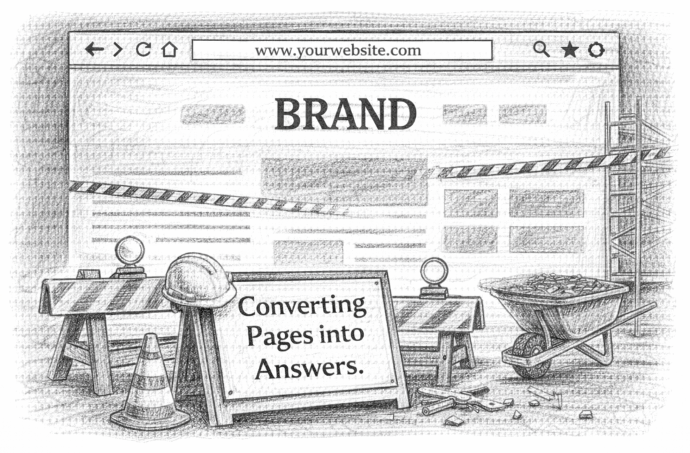
Most AEO platform demos look alike. A dashboard, a line going up, a list of prompts. The differences show up in the questions a vendor cannot answer. This checklist gives you twelve to ask, why each matters, and what BrandRank.AI answers. Use it as an RFP outline or as a script for the second call.
Amazon, Target and Nordstrom lead AI retail recommendations, challenger brands break through, and four retailers capture 80% on delivery, returns and support.
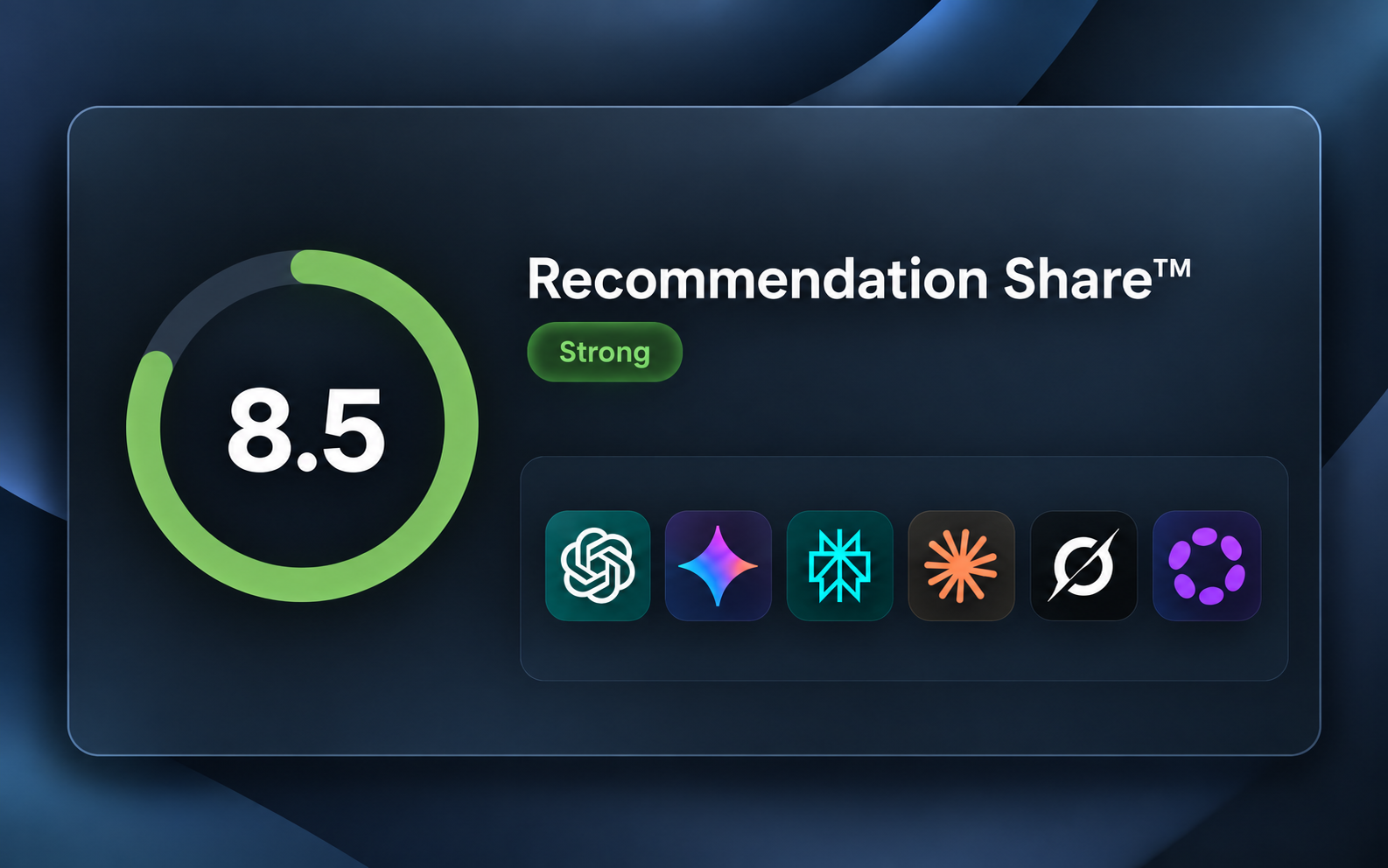
Most AEO platforms report share of voice: the percentage of AI answers in which your brand is mentioned. Recommendation Share™ is a different number. It weights each mention by the position the engine gave it, so the brand named first gets full credit and a brand named eighth gets little. The two metrics can move in opposite directions. This article explains the method, works through an example, and shows why the position-weighted number is the one that tracks revenue.
Answer Engine Optimization (AEO) is the practice of getting a brand named in the answers that ChatGPT, Gemini, Perplexity, Claude, Grok, Meta AI, and DeepSeek give to buying questions. An AEO platform is the software that measures whether that is happening and tells you what to fix. This guide explains what an AEO platform does, what separates the good ones, and where BrandRank.AI sits in the category.
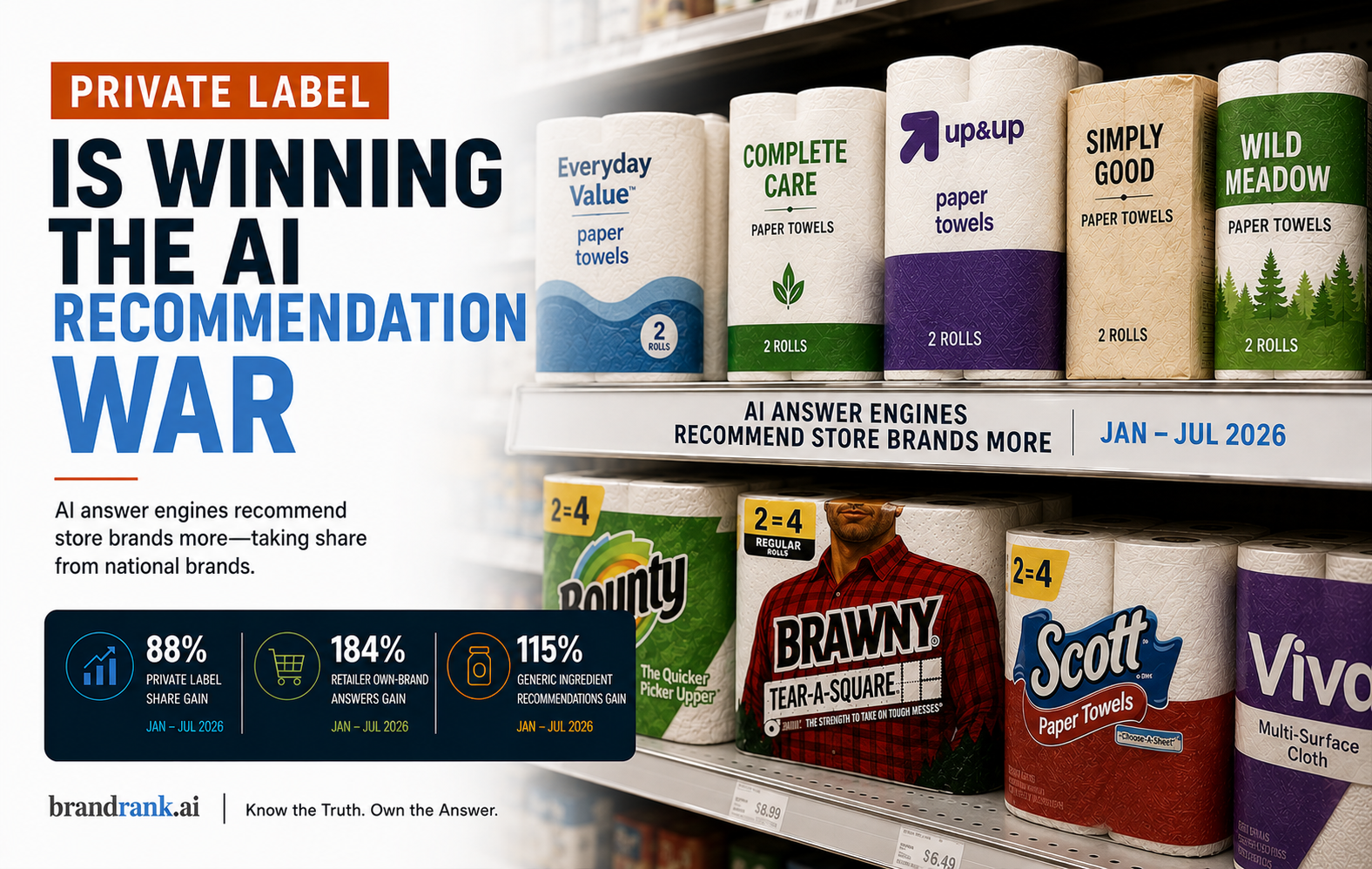
Quick answer: Yes — AI answer engines are systematically favoring private label over national brands. BrandRank.AI tracked 4.3 million AI recommendations across ChatGPT, Claude, Gemini, Grok, and Perplexity from January to July 2026, and found private label, retailer own-brand programs, and generic ingredients gained 2.7 percentage points of Recommendation Share — taken directly from national brands, not from a growing pool of options.
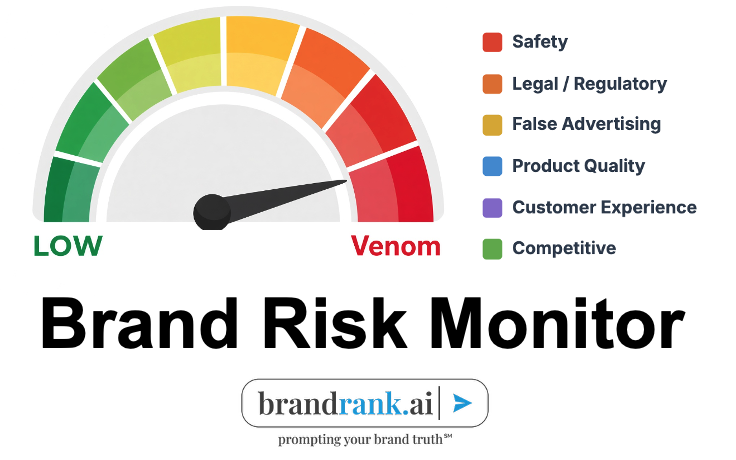
BrandRank.AI today announced the launch of Brand Risk Monitor, a source-level intelligence capability that helps reveal the raw material driving unfavorable Recommendation Share™, and the government, regulatory, news and independent sources behind it.
Series Seed Financing to Help Brands Win, Defend Trust & Grow Recommendation Share in AI Answer Engines & Build on Averi Acquisition to Drive Enterprise Growth
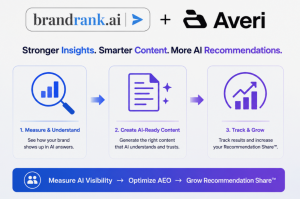
BrandRank.AI today announced it has completed a strategic transaction to acquire the core assets, technology, select team members, and customer relationships of Averi.ai, adding AI-assisted content creation capabilities to the company's AI Content Readiness platform. The acquisition enables organizations to move directly from identifying opportunities for improvement to creating content designed to strengthen their Answer Engine Optimization (AEO) strategy and improve their Recommendation Share™ across AI Answer Engines.
In The Answer Economy, employee experience is no longer internal — it’s a primary input into how AI answers rank and recommend brands. Ignore at your peril.
Hover message If you look across the sources that inform AI search results in consumer health and wellness, a handful of websites consistently underlie how consumer health answers get constructed. What’s interesting isn’t just which sites show up—it’s how differently each AI model leans on them, and what that says about how “truth” gets assembled. Let’s start with the anchor: Healthline. Think of it as the baseline unit of influence. Other key sites influence can be framed relative to that. Healthline: The Baseline (1.0) Healthline is the closest thing to a universal translator across AI systems. Its influence is evenly distributed, showing up across nearly every major model rather than being concentrated in one. What drives this dominance is breadth and format. Healthline doesn’t just do condition explainers or product roundups it does both, and does them in a way that’s structurally easy for language models to parse. Whether the query is “what is this symptom?” or “what should I take for it?”, Healthline is almost always relevant. The result: it becomes a default reference layer. Not because any one model overweights it, but because all of them do enough to make it unavoidable. Amazon: ~0.6 of Healthline Amazon shows up differently, more a proxy for consumer behavior than a true health authority. Its influence is concentrated in certain models that treat marketplace signals (sales rank, review volume, availability) as a form of credibility. In those systems, “what people buy” becomes shorthand for “what works.” This creates an interesting dynamic: Amazon isn’t shaping the medical framing of answers, but it is shaping the recommendation layer. It’s where AI systems swap clinical reasoning for behavioral data. And while Amazon has clearly taken steps to block or limit AI crawlers those constraints seem to be applied to crawling the entire site as training data, AI crawlers seem to have no problem accessing individual Amazon PDPs. WebMD: ~0.3 of Healthline WebMD plays a more traditional role: it supports the clinical backbone of responses. Its influence is strongest in models that lean heavily on structured medical authority. When queries are about symptoms, conditions, or standard treatments, WebMD becomes a stabilizing force—less about discovery, more about validation. Compared to Healthline, it’s narrower in scope. It doesn’t compete as aggressively in product-oriented queries, which limits its overall footprint. But where it does show up, it carries a certain “this is what doctors say” gravitas that models seem reluctant to contradict. Verywell Health: ~0.25 of Healthline Verywell Health operates as the reliable understudy. It rarely leads, but frequently appears alongside other sources, reinforcing similar conclusions. Its content sits in the middle ground—part educational, part recommendation-driven—which makes it broadly usable but less distinctive. In practice, it functions as corroboration. When multiple sources are needed to make an answer feel complete, Verywell often fills that second slot. Forbes Health: ~0.2 of Healthline (with a caveat) Forbes Health is the outlier, not because of its format, but because of how unevenly it’s cited. Its influence is heavily concentrated in a single AI family, which accounts for the vast majority of its citations. In other answer engines, it barely registers. What drives its presence is its structure: ranked lists, product comparisons, and cleanly packaged recommendations. These are tailor-made for AI extraction, especially for queries that explicitly ask for “best” options. The catch is that its overall influence can look larger than it really is if you don’t account for that model specific concentration. The Bigger Pattern What emerges from all of this is that AI systems don’t agree on what “authority” looks like—they just each have a coherent version of it. Some prioritize editorial health content (Healthline, Verywell) Some lean into clinical reinforcement (WebMD) Others incorporate consumer behavior signals (Amazon) And a few show strong preferences for structured recommendation content (Forbes-style lists) Healthline wins not because it’s the most specialized, but because it’s the most compatible with all of these approaches at once.
In the emerging Answer Economy, your brand no longer has a single reputation. It has many. And most brand builders have very little visibility into what those reputations actually look like.
In the emerging Answer Economy, better questions may matter more than better answers. The Socratic Method never disappeared. We just replaced it with a search box. For decades, we outsourced our curiosity to search engines — which trained us to ask small, keyword-sized questions. "Best running shoes." "Weather tomorrow." "How to boil an egg."
Pete Blackshaw·
Newsletter
Get The Prompted Perspective in your inbox
One short email each time we publish — what AI answer engines are saying
about brands, and what changed. Unsubscribe anytime.

.png?width=1586&height=992&name=AEO%20Platform%20Buyer%E2%80%99s%20Checklist%20(1).png)