In the emerging Answer Economy, your brand no longer has a single reputation. It has many. And most brand builders have very little visibility into what those reputations actually look like.
Consumers are increasingly learning about brands through AI-generated answers rather than traditional search results. When someone asks questions like “What’s the healthiest drink?”, “What beverage brand is most sustainable?”, or “What’s the best sports drink?”, they are increasingly receiving answers generated by large language models rather than lists of links. These responses shape brand discovery, credibility, and ultimately purchase intent.
The important implication for marketers is that each AI engine evaluates brand authority differently. The same question asked across multiple systems can surface very different brands depending on the signals those systems prioritize.
The New Influencers
In many ways, these systems have become the new influencers.
ChatGPT, Gemini, Claude, Grok, Perplexity, and DeepSeek collectively process billions of prompts every day, helping consumers evaluate brands, compare products, and make decisions about what to buy. Unlike traditional influencers, however, these systems cannot be paid, negotiated with, or directly persuaded. They simply generate answers based on the information and signals they have learned to trust.
Understanding those signals is becoming an important new discipline for brand leaders.
Testing Brand Authority in the Beverage Category
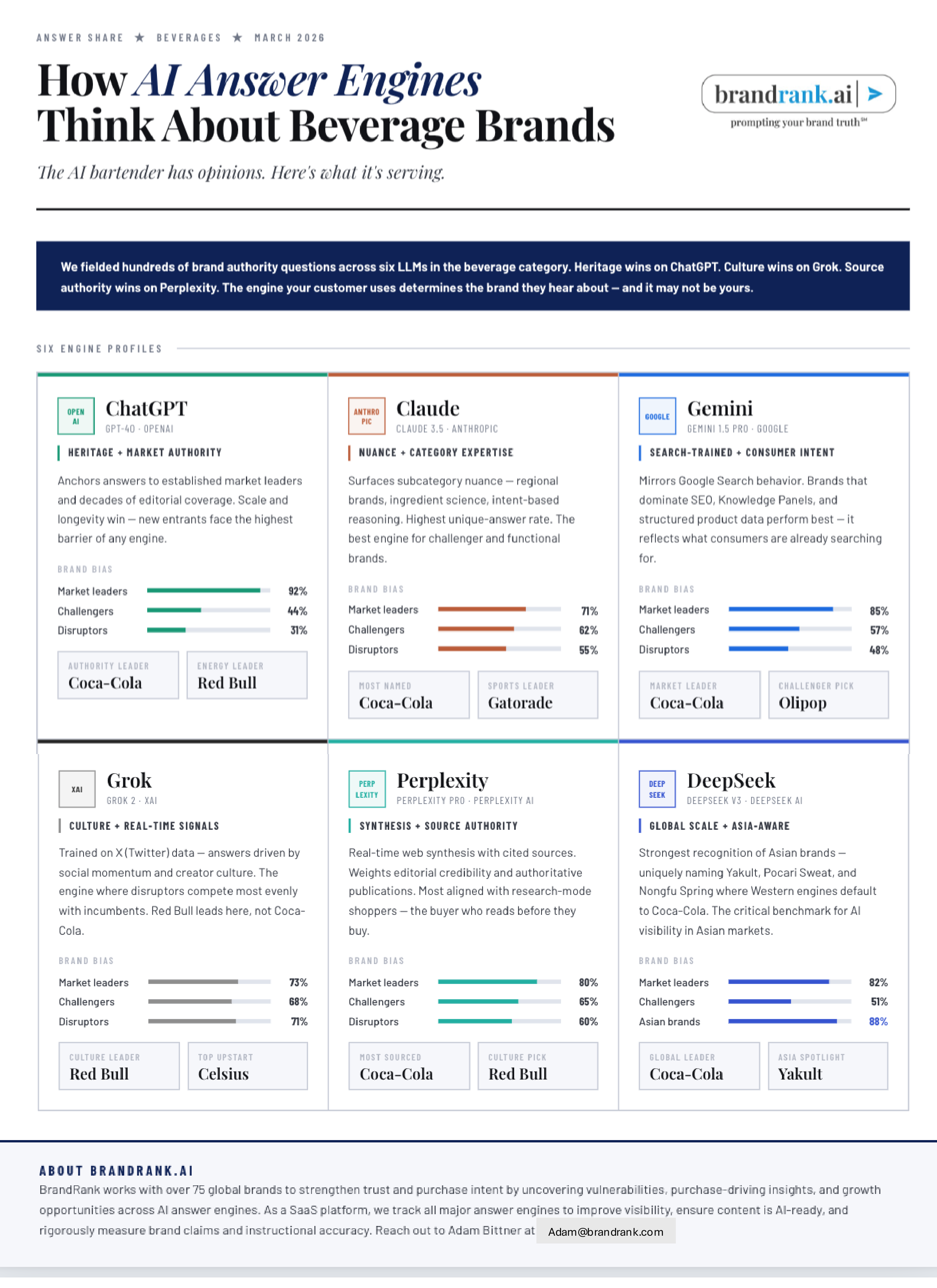
To explore how these systems differ, we recently fielded hundreds of brand authority prompts across six major LLM platforms in the beverage category. Prompts included questions such as:
- What is the healthiest drink?
- What beverage brand is most sustainable?
- What’s the best sports drink?
- Which soda brand is most iconic?
While the questions were identical across platforms, the answers were not. What emerged were clear and repeatable patterns in how different engines evaluate brand authority.
Each platform, in effect, operates with its own model of credibility.
How Different AI Engines Think About Brand Authority
CHATGPT: Heritage and Editorial Depth
ChatGPT consistently rewards brands with deep and well-established editorial footprints. Companies that have accumulated decades of press coverage, encyclopedic references, and structured public information tend to perform strongly in its answers.
This dynamic favors legacy brands that have built a long record of cultural visibility. Coca-Cola, for example, benefits enormously from decades of public documentation, media coverage, and global recognition.
For marketers, the implication is straightforward: long-term content authority matters. Brands that have not invested in building a strong public information footprint may find that ChatGPT simply does not recognize them as credible authorities.
GEMINI: Search Authority
Gemini reflects many of the same signals that historically drove Google Search. Brands with strong SEO foundations, well-developed knowledge panels, structured product data, and high-quality websites tend to appear more frequently in Gemini’s responses.
In practical terms, this means that your Google presence strongly influences your Gemini presence. The same signals that help brands dominate search results increasingly shape AI answers as well.
For marketers who believed SEO might be declining in importance, the opposite may be true. SEO is evolving into something broader: a core part of AI visibility infrastructure.
CLAUDE: Claim Scrutiny
Claude demonstrated perhaps the most rigorous approach to evaluating brand claims. In many prompts, it scrutinized sustainability messaging, health benefits, and product performance claims more critically than other engines.
Brands that relied on vague or unsupported assertions were less likely to appear in authoritative answers. Claude appeared to weigh reasoning and supporting evidence more heavily than reputation alone.
For marketers, this suggests that credibility and substantiation are becoming increasingly important signals in AI-driven brand evaluation.
GROK: Cultural Momentum
Grok’s answers appeared to be influenced strongly by real-time cultural signals, particularly from X (Twitter). Brands that generate strong social conversation, community engagement, or creator-driven attention often surfaced prominently.
This creates opportunities for challenger brands with strong cultural momentum. Companies that successfully engage online communities or participate in ongoing social conversations may gain visibility in ways that traditional brand scale alone cannot guarantee.
For marketers, this reinforces the importance of cultural participation as a signal of brand relevance.
PERPLEXITY: Source Credibility
Perplexity places strong emphasis on citation and editorial authority. The engine frequently references well-known publications, expert commentary, and third-party sources when generating answers.
Brands that appear frequently in credible media coverage or authoritative editorial content tend to perform well within this system.
The implication for marketers is that earned media and PR strategy increasingly influence AI visibility. Third-party validation may be one of the most powerful signals shaping brand authority in citation-based answer engines.
DEEPSEEK: Global Perspective
DeepSeek produced some of the most surprising outcomes for Western brand teams. Because of its broader global training data, it sometimes surfaced brands that Western models overlooked.
In our beverage prompts, DeepSeek frequently referenced Yakult, a globally dominant probiotic drink brand, where several Western engines defaulted to American beverage companies.
This highlights an important point for companies with international ambitions: global training data changes the brand landscape. DeepSeek may offer a better lens into how brands are perceived in markets beyond North America and Europe.
What the Results Revealed
Across our scorecards, Coca-Cola dominated, often appearing as the consensus answer across multiple prompts and platforms. This outcome illustrates how historical brand authority compounds over time. Decades of media coverage, cultural visibility, and public information create a powerful advantage in AI-generated answers.
However, the most interesting findings emerged beyond the category leader. Several emerging brands appeared strongly on specific engines while remaining nearly invisible on others. This fragmentation suggests that AI answers are not simply reinforcing the existing brand hierarchy—they are also creating new opportunities for challenger brands.
Companies that fail to understand these dynamics may feel the effects first in consumer perception and purchase intent, well before those shifts appear in traditional measurement systems like Nielsen or Circana.
The Same Pattern Across Categories
We see similar dynamics in other industries. In our Answer Share: Cleaning study, brands such as Blueland, Seventh Generation, and Scrub Daddy surfaced strongly in certain engines even in areas where legacy brands historically dominated consumer awareness.
The pattern suggests that AI answer engines are not merely repeating existing brand hierarchies. Instead, they are interpreting authority through different lenses, which can open the door for newer brands that have built strong signals in specific areas such as sustainability, editorial coverage, or cultural relevance.
A New Discipline for Brand Leaders
The key takeaway is that brand authority is no longer singular. Each AI engine defines it differently. Some prioritize heritage and editorial depth, while others emphasize cultural momentum, source credibility, search authority, or global awareness.
This shift represents more than an evolution of search optimization. It signals the emergence of an entirely new marketing discipline: AI brand visibility.
The CMOs who understand how answer engines interpret authority will gain an advantage that compounds over time, particularly as AI answer share and market share begin to converge. Understanding how brands surface in these systems is quickly becoming a core part of modern brand strategy.