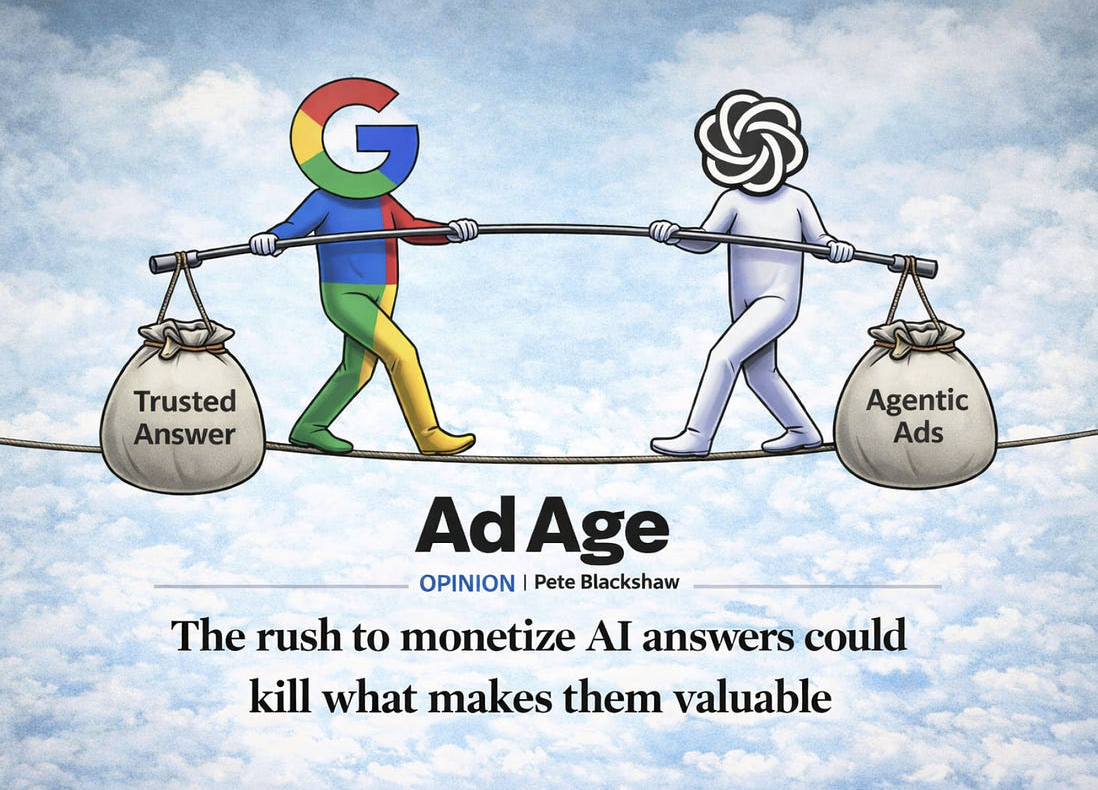
Consumers can tolerate ads in AI. What they won't tolerate is not knowing when commercial influence shapes the answer.
 |
“Ads do not influence the core organic model.”
That was the promise OpenAI monetization chief Asad Awan recently made about ChatGPT advertising in comments reported by Axios It may turn out to be one of the most consequential promises in the history of digital advertising. Because if consumers stop trusting AI answers, the commercial future of conversational AI becomes unstable.
Starting last week, OpenAI began rolling out a beta self-serve advertising platform for ChatGPT in the U.S., removing the high-spend barriers that had previously limited participation largely to large brands and agency-managed pilots. The commercial opening of the AI answer layer is now underway.
This moment feels familiar.
When social media marketing exploded in the mid-2000s, marketers rushed into a new communications environment before norms had fully formed. The early years brought enormous creativity — and enormous abuse. Fake grassroots campaigns, hidden sponsorships, undisclosed influencer relationships and manufactured reviews eventually forced the industry into a reckoning around transparency and trust.
Many of us involved in the early word-of-mouth and social media movement realized something important: once commercial influence becomes invisible, trust itself becomes unsustainable. That realization eventually led to disclosure standards, ethics codes and FTC enforcement around influencer transparency.
The Answer Economy now faces a similar crossroads — except the stakes are higher.
Why Conversational AI Is Different
In social media, people scrolled and reacted. In conversational AI, people increasingly rely on answers. Consumers ask ChatGPT, Gemini, Anthropic Claude, X Grok, DeepSeek AI and Perplexity which products to buy, which medications are safest, which financial services to trust and which businesses deserve consideration. Increasingly, these systems will not just recommend — they will act on our behalf.
That changes the trust equation completely.
The issue is not advertising itself. Advertising can absolutely have a constructive role inside AI systems.
OpenAI is right to argue that ads can help subsidize access to powerful AI tools. There is nothing inherently unethical about commercial participation inside conversational interfaces.
The issue is whether consumers can clearly distinguish between independent answers and commercially influenced ones.
In traditional search, the distinction between paid and organic was largely visual. Sponsored links were labeled. Users learned the difference quickly. In AI systems, that separation becomes far harder to inspect. The boundary between an “organic” recommendation and one shaped by commercial incentives is often invisible to the user.
And the real risk is not obvious advertising. The real risk is invisible optimization — where commercial incentives quietly shape recommendations at moments when consumers believe they are receiving neutral guidance.
Imagine a financial AI assistant subtly prioritizing higher-fee financial products because commercial incentives influence recommendation weighting. Or a healthcare chatbot steering vulnerable consumers toward sponsored treatment providers during moments of fear or uncertainty. The danger is not simply manipulation. It is the erosion of confidence in the neutrality of the answer itself.
In conversational systems, perceived manipulation can become as damaging as actual manipulation. Once users begin questioning whether answers are commercially distorted, trust erosion accelerates quickly.
The Ad Stack Is Already Reassembling
One reason this debate matters now is that the commercialization layer around AI is already expanding far beyond simple sponsored prompts or branded responses.
The familiar architecture of modern adtech is quietly reassembling itself around conversational AI: targeting, optimization, attribution, performance measurement and automated campaign management.
Recent reports suggest OpenAI is already working with major advertising and commerce infrastructure partners as it scales its ad platform. That may be commercially inevitable. But it also introduces a deeper challenge the industry has seen before: optimization drift.
The greatest risk may not be deliberate manipulation. The greatest risk may be gradual optimization drift — where commercial incentives slowly shape recommendation behavior in ways that become difficult to detect, measure or reverse.
Nobody begins by saying, “Let’s compromise answer integrity.” But over time, monetization systems naturally optimize toward engagement, conversion and revenue performance. Search and social media followed that trajectory. AI companies now face pressure to prove conversational systems can evolve differently.
The trust debate is no longer confined to whether ads appear inside answers. It increasingly extends to the broader economics of AI monetization: data collection practices, targeting infrastructure, recommendation weighting and commercial influence over decision-making systems.
That matters because conversational AI is fundamentally different from entertainment media.
 |
In a recent (and very important) post, journalist and tech historian John Battelle captured the irony sharply, noting that OpenAI is now using “aggressive, performance- and data-driven” advertising tactics to build what may become the next great advertising platform. His comparison was TikTok, which used aggressive digital advertising to accelerate its own growth.
But TikTok sold attention. AI systems increasingly sell trust in answers. That distinction matters enormously.
The Invisible Influence Problem
This is why the industry now needs a serious conversation around voluntary standards for commercial transparency and answer integrity — before the first major scandal forces regulators to do it instead.
Trust is the economic infrastructure of the Answer Economy. Once consumers believe AI recommendations are secretly rigged or commercially distorted, everyone loses: platforms, advertisers, publishers and consumers alike.
Some principles should already be obvious:
- no sponsored answers disguised as independent recommendations;
- no hidden conflicts of interest in comparative recommendations;
- no fabricated citations or invented evidence;
- no exploitation of vulnerable consumers — health crises, financial distress, grief or emotional instability — for manipulative targeting.
But the next phase requires more than disclosure.
The industry needs measurable standards around answer integrity. Independent researchers and auditors should be able to test whether advertiser participation influences recommendation frequency, sentiment or answer quality. Commercial transparency cannot rely entirely on platforms policing themselves behind closed doors.
 |
The industry also lacks something digital advertising eventually developed over decades: independent verification infrastructure. Search and social platforms ultimately evolved systems around fraud detection, measurement standards, brand safety and third-party auditing. Conversational AI still lacks comparable accountability frameworks.
The future may also require something far more foundational: answer provenance.
In the Answer Economy, transparency is no longer just about labeling ads. It is about preserving provenance — the ability to understand why an answer was generated, what sources informed it and whether commercial incentives shaped the outcome.
Search engines gave consumers links they could inspect. AI systems increasingly provide synthesized judgments that are harder to reverse-engineer.
As AI becomes more conversational and agentic, consumers may need something closer to “nutrition labels” for answers — standardized disclosures explaining whether commercial relationships, affiliate incentives or paid prioritization influenced recommendations.
And unlike search, conversational systems compress plurality into a single synthesized response. When a search engine disappointed users, they clicked another link. When a conversational system disappoints users, it can feel like the assistant itself betrayed them.
When Recommendations Become Actions
The challenge becomes even more urgent as AI systems evolve from answer engines into agentic systems capable of taking actions directly for users — booking travel, purchasing products, selecting vendors, managing subscriptions and negotiating transactions.
When AI moves from recommending to doing, disclosure requirements become far more important.
Consumers deserve to know whether commercial relationships influenced a decision before an action occurs — not buried afterward inside terms of service nobody reads.
At that point, the distinction between advertising, recommendation and fiduciary responsibility begins to blur.
Brands also need to reckon with the fact that advertising alone will not guarantee success in the Answer Economy. AI systems synthesize the entire record: reviews, complaints, customer service histories, regulatory filings and credibility signals across the web.
Advertising is a complement to trustworthiness, not a substitute for it.
Trust itself may also become a competitive differentiator among AI companies. Some platforms may eventually position themselves explicitly around reduced commercial influence, greater transparency or subscription-first business models. The companies that preserve trust most effectively may ultimately gain strategic advantage.
 |
Governance Before Scandal
The alternative is predictable: scandal first, governance later.
We’ve seen that movie.
Which is why the industry should move now — not after the first major controversy — to establish independent auditing frameworks, transparency reporting standards, adversarial testing protocols and cross-industry ethics guidelines around commercial influence in AI systems.
The companies that win trust in the Answer Economy will not simply be the ones with the best models or the largest advertising ecosystems. They will be the ones that can demonstrate — measurably, transparently and independently — that consumer interests remain protected inside increasingly commercialized AI environments.
Which brings us back to those eight words:
“Ads do not influence the core organic model.”
If OpenAI keeps that promise — measurably, auditably, independently verified — it becomes the foundation of something the internet has never quite managed to build: a commercial medium people actually trust.
If they don’t, we’ll know soon enough. So will everyone else.
The next decade of AI commerce may ultimately hinge on a simple question: will conversational systems become the most trusted interface consumers have ever used — or simply a more persuasive version of the attention economy we already regret?
Pete Blackshaw is CEO of BrandRank.AI and author of the forthcoming The Answer Economy: How AI Agents Will Shape Your Brand’s Future (Wiley). He helped shape word-of-mouth ethics standards in the mid-2000s and served as Global Head of Digital at Nestlé. He spearheaded the Consumer Goods Forum first-ever “Consumer Engagement Principles,” chaired the national Council of Better Business Bureaus and in that capacity served on the National Advertising Review Board.
Important Voices in this Conversation (Tell Me Who I’m Missing. I’m buildlng A Master List)
Debra Aho Williamson — Founder of Sonata Insights and author of The AI Ad Economy, Williamson is one of the clearest analysts tracking how generative AI is reshaping advertising, search, consumer discovery, and media economics — with a strong focus on trust, transparency, and platform accountability.
Richard Sussman — A longtime advocate for advertising ethics and a key figure behind the Institute for Advertising Ethics (IAE), Sussman has been vocal about the need for AI transparency, ethical persuasion standards, and preserving consumer trust as AI becomes embedded in advertising systems.
John Battelle — Journalist, entrepreneur, and author of The Search, Battelle has become a leading voice on how AI could transform the “database of intentions,” warning that advertising-driven AI business models may recreate many of the trust and manipulation problems of social media.
Grace Yee — Adobe’s Senior Director of Ethical Innovation, Yee is helping shape practical standards for responsible AI in creative and marketing ecosystems, particularly around provenance, disclosure, creator rights, and governance.
Shelly Palmer - A longtime champion of the advertising, media, and technology industries, Palmer has consistently asked the hard questions about AI’s impact on trust, authenticity, intellectual property, and consumer manipulation. His work stands out because he embraces innovation while insisting that the industry preserve the integrity, transparency, and human value at the core of advertising and media.