
Where BrandRank.AI measures your brand's standing, The Answer Economy gives your leadership team the playbook to change it.
How AI Agents Will Decide Your Brand's Future
Billions of consumers now ask AI what to buy, where to go, who to trust. Instead of scrolling pages of links, they get one recommendation. The brands AI chooses — and the ones it ignores — will define the next era of competition.
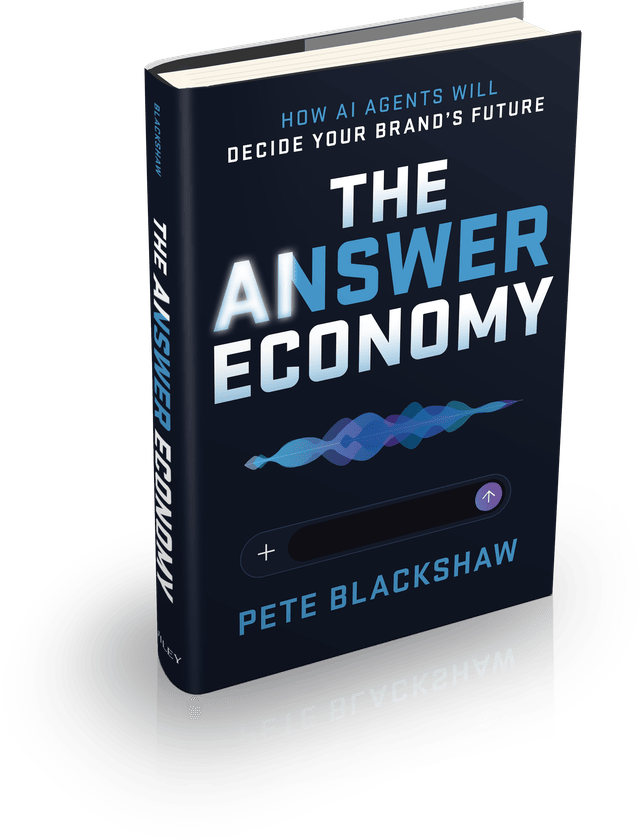
AI has already reset what customers expect, forcing every function, from R&D to customer service, to reorganize around one question: does this company deserve to be recommended? The Answer Economy gives leaders the specific moves to make that change deliberately, not reactively.
Use "Prompted Moment of Truth" and "Recommendation Share" to put AI brand risk on the board agenda.
Use the "answer owner" model to make cross-functional accountability a role, not a turf fight.
Translate "AI visibility" into evidence, responsiveness, and credibility — language the whole org already values.
Request time with BrandRank co-founders Pete Blackshaw or Hank Hudepohl to brief your executive team or board on the answer economy — where AI agents, not search results, are deciding whether your brand gets chosen.
A focused session for your top executives or board — built around your brand's own AI answer-share data, not generic AI trends.
They don't just inform the room. They disrupt how leadership thinks about brand trust, using evidence specific to your category.
A shared vocabulary and a clear-eyed framework your leadership can act on immediately — not just admire.
We're an invitation-only community — hundreds of the world's top marketers and brand executives, all preparing for the C-suite or the boardroom. Pete's The Answer Economy thesis consistently earns our highest session ratings. It's become an anchor leadership track for the next generation of executives we serve.Drew IanniThe Athena Project · Former DCX & Ad Tech Coordinator
Uncover where your brand actually stands in the Answer Economy — and what it takes to be the one AI recommends. Tell us about your organization and timing, and we'll follow up to scope a session for your executive team or board.
Everyone in the room gets the bookEvery attendee receives a copy of The Answer Economy, so your leadership team leaves with the playbook, not just the session.
Bring the ideas from The Answer Economy to your leadership team. Order copies for your organization and unlock additional access to Pete based on your order size.
The more copies, the more access to Pete
A 30-minute virtual Q&A with Pete for your team.
Order via Porchlight → 50+ CopiesA one-hour virtual conversation or presentation with Pete for your organization.
Order in bulk → 250+ CopiesPete will speak at your event — in lieu of a speaker fee.
Order in bulk →Orders under 50 copies are fulfilled by Porchlight Book Company, the leading source for business-book bulk orders. Orders of 50 or more go through our Books-A-Million bulk ordering page.

The rise of the AI agent as your new best friend, and the urgent problems ahead
The Answer Economy shows how the answer decides. Second Self asks what happens when the one answering becomes your customer's closest confidant.
The questions readers ask before they pick up The Answer Economy.
The Answer Economy describes a fundamental shift in how decisions are made, where consumers no longer search, compare, and decide, but instead ask AI systems for guidance and receive synthesized answers that shape outcomes before they engage with any brand. Answers replace lists, and recommendations replace exploration, moving the critical moment of influence upstream into the answer itself. As a result, brands are no longer competing primarily for attention — they are competing to be selected.
Pete Blackshaw has spent more than three decades studying how consumers shape brands, from early interactive marketing at Procter & Gamble to founding PlanetFeedback and leading global digital strategy at Nestlé. His work has consistently focused on how trust is built when consumers gain more control. This book represents the next evolution of that work, examining how AI systems now interpret and act on collective consumer signals at scale, fundamentally reshaping how brands are understood and chosen.
Search was built around consumer effort, presenting options that required evaluation, comparison, and judgment, with SEO helping brands surface in that process. In the Answer Economy, that work is increasingly done by AI systems, which synthesize information, evaluate credibility, and deliver a single or limited set of recommendations. This compresses the decision process and shifts marketing from being discoverable to being defensible, where inclusion depends on whether a brand can be clearly and credibly recommended.
The Answer Divide is the gap between how AI systems answer questions and how brands do. AI systems are always on, responsive, and designed to satisfy curiosity, delivering direct, structured, and often empathetic answers without friction or commercial pressure. Brands, by contrast, are typically optimized for conversion, resulting in responses that can be incomplete, hard to access, overly promotional, or evasive. When these two systems meet, AI fills the gap.
In the Answer Economy, brand performance is best understood through three metrics: Visibility, Vulnerability, and Readiness. Visibility reflects whether a brand appears in AI-generated answers to meaningful questions. Vulnerability captures where those answers introduce doubt, inconsistency, or risk. Readiness indicates whether a brand is structurally prepared to be selected through clear, consistent, and machine-accessible information. Together, these metrics form a new scoreboard that operates before traditional measures like traffic or conversion.
Many strong brands were built for a system that rewarded awareness, messaging, and emotional connection, but AI systems prioritize clarity, consistency, and verifiable information. A brand can be widely recognized and still fail to appear in AI-generated answers if it has not clearly documented how it performs across specific questions or use cases. In this environment, familiarity does not guarantee inclusion, and absence often reflects a lack of structured, accessible answers rather than a lack of quality.
AI systems recommend brands they can confidently explain and defend, which requires clear claims, consistent information across sources, and evidence that can be verified or corroborated. They look for alignment between product documentation, customer experience, third-party validation, and public narrative, rewarding coherence over creativity. When those elements reinforce one another, a brand becomes easier to recommend; when they conflict or remain incomplete, the system hedges or excludes the brand.
Different AI platforms are built with different priorities, with some emphasizing decisiveness, others caution, and others transparency or source attribution. As a result, one system may confidently recommend a brand while another offers a broader set of options or avoids endorsement altogether. These differences reflect variations in how each system defines credibility, manages risk, and interprets available information, rather than inconsistencies in the brand itself.
Ask-Through behavior describes a shift from navigating across websites to interacting within a single conversational interface, where consumers ask a question, receive an answer, and refine their decision through follow-up questions. This compresses the traditional journey into a continuous dialogue, reducing the role of clicks and increasing the importance of how answers perform across multiple conversational turns. Brands must now succeed within this dialogue, not just on their own platforms.
AI answers often feel more trustworthy because they are perceived as synthesized rather than self-interested, combining information from multiple sources into a coherent and explanatory response. They tend to surface trade-offs, avoid overt persuasion, and present information in a way that feels neutral and informative. For brands, this shifts trust from what is claimed to what can be consistently verified across the broader ecosystem that AI systems draw from.
Trust remains central, but it is now inferred algorithmically rather than built solely through direct brand experience or messaging. AI systems evaluate patterns across sources, looking for consistency, validation, and alignment, and use those signals to determine what to recommend. Trust is no longer something a brand declares or gradually accumulates — it is something continuously assessed based on the coherence of its presence across the information landscape.
Leaders should begin by recognizing that this shift is already happening and asking a simple but critical question: what does AI say about our brand before we say anything? From there, they can evaluate their position across Visibility, Vulnerability, and Readiness and focus on improving the clarity, consistency, and accessibility of their answers. The goal is not to control AI, but to influence the inputs it relies on, ensuring that when questions are asked, the brand is both present and credible in the response.

Pete is a regular opinion contributor to Ad Age, where he has been writing from inside the Answer Economy since 2023 — naming the shift years before the market caught up.
Read the book that's defining how marketing leaders think about the Answer Economy — then see where your own brand stands with BrandRank.AI.