The key comparison: ad separation
The most revealing contrast across platforms isn’t targeting, bidding, or formats.
It’s how each platform defines and enforces ad separation.
- OpenAI / ChatGPT
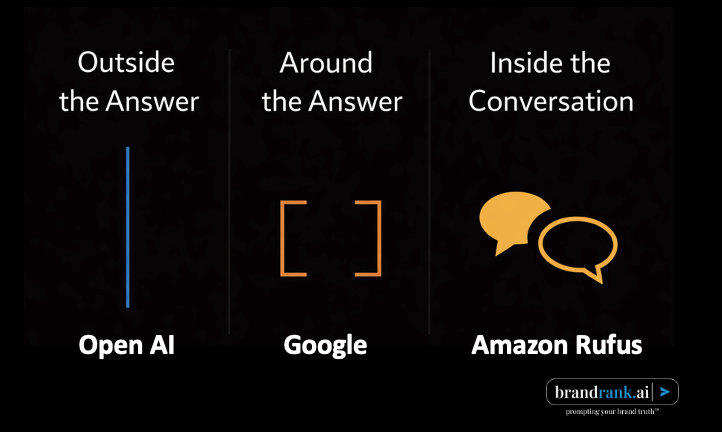
Ads are separate, clearly labeled, and explicitly do not influence answers — what OpenAI has described as answer independence.
- Google / Gemini + AI Overviews
Ads appear in clearly labeled “Sponsored” breakout sections, visually distinct from organic AI answers and generally aligned to high-intent, decision-ready contexts.
- Amazon Rufus
Ads are embedded within the conversational interface — including Promoted Prompts — labeled as sponsored but more tightly woven into the interaction itself.
Same direction. Very different implementations.
Why this distinction matters
AI answers don’t inherit the familiar structure of search or social:
no links page, no fixed ad units, no obvious handoff between “content” and “commercial.”
As a result, separation becomes a design decision, not just a placement rule.
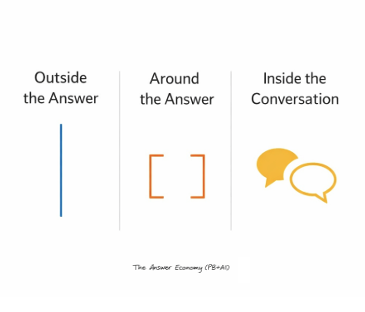
- OpenAI separates ads from answers.
- Google separates ads around answers.
- Amazon integrates ads within the conversational flow.
That difference may seem subtle now, but it shapes how users interpret intent, relevance, and credibility — and it’s something CMOs should understand early, before optimization, scale, and performance pressure take over the conversation.
A final thought
We are clearly in the early chapters of this story. The models are forming, the interfaces are evolving, and the balance between consumer trust and business necessity is still being worked out.
That’s why thoughtful industry voices — including @Debra Aho Williamson, who has been doing pioneering work in this area — are so important right now. This moment needs framing and clarity, not just experimentation.
My own guiding principle as we sort through these tradeoffs is straightforward:
Trust your inner consumer.
When an ad appears inside or alongside an AI answer, the most immediate signal isn’t a KPI — it’s the gut check. Does it feel helpful? Does it feel coherent with the answer? Does it respect the reason you asked the question in the first place?
We’ll spend much of 2026 exploring what the right models look like and how judgment should be applied.
For now, simply understanding how differently the platforms are drawing the lines — and how early we still are — is the real takeaway.