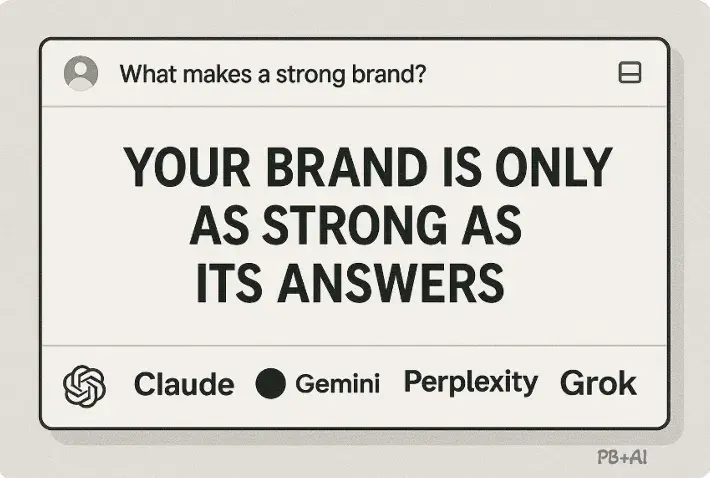
In the Answer Economy, the Answer is the Shelf. And you didn't build it.
I’ve been watching something happen in slow motion for the past two years. And then, in the past two months, it stopped being slow.
 |
Every week brings another structural move in what I’ve been calling the Answer Economy — the emerging world where AI-generated answers mediate the relationship between brands and consumers.
Platforms pulling ads. Platforms adding ads. Retail checkout embedded inside conversational AI. Agents layered into devices. Promises about trust and neutrality made in press releases while monetization experiments run quietly in the background.
The pace isn’t just fast. It’s compounding. (See Debra Aho Williamson’s excellent piece last week: AEO and AI Media are Converging Faster than You Think!
The Invisible Shelf
I’ve been calling it the Invisible Shelf.
In the physical world, brands fought for shelf placement — eye level, end caps, checkout proximity. In the digital world, they fought for search rankings and paid placements. You could see the shelf. You could measure it. You could manage it.
In the Answer Economy, the shelf is invisible. It lives inside a model’s synthesis — assembled in milliseconds from thousands of sources, weighted by signals brands don’t control, and delivered as a single confident answer. No packaging. No placement fee. No second impression.
The consumer never sees the shelf. They only see the answer. And right now, most brands have no idea what that answer says about them.
Why Trust — and Why Now
I’ve spent my career at the intersection of brands, consumers, and credibility. From Procter & Gamble to serving as National Chairman of the Better Business Bureau, and now through BrandRank.AI — the throughline has always been the same question: what makes consumers believe you?
The rule has never changed. Trust is not a soft metric. It is the trigger — the variable that determines whether a consumer acts or walks away. What has changed is the velocity. Trust is now won, lost, and mediated at machine speed.
And the machines doing the mediating are making very different bets about how to handle it. That tension — between answer credibility and monetization — is the defining strategic question of the Answer Economy. Every player I’m tracking in this first edition is navigating it differently. Some are betting that trust is the product. Others are betting that trust is durable enough to survive monetization. Others are buying time.
We’ll find out who’s right.
From Click-Through to Ask-Through
The Prompted Moment of Truth™ has arrived.
For decades, digital marketing revolved around click-through. Traffic was currency. Rankings were oxygen. The funnel was observable, measurable, and optimizable. Brands invested billions learning how to move consumers through it.
That model is collapsing.
I would go so far as to say we’re entering a Zero Click world. More precisely, what I see is a transition from Click-Through to what I call Ask-Through — where value is created inside an iterative, deepening exchange. One question leads to refinement. Refinement leads to narrowing. Narrowing leads to decision. Amazon Rufus may be the clearest real-world example — a system that keeps throwing questions back at you, deepening the conversation in real time.
 |
The hard truth for brands: being Ask-Through ready barely exists as a concept in most marketing departments. It needs to become a core capability — fast. Because in the Ask-Through era, the entire purchase journey can compress into a single conversational exchange. No landing page. No retargeting loop. No second click. Just the answer.
The First Power Index: Six Players, One Question
In this month’s power index, we track six players — Perplexity, Google, Walmart, OpenAI, Samsung, and one wildcard — Anthropic — that was all over the news this weekend, Anthropic — each navigating the central tension of the Answer Economy in their own way.
Perplexity made the boldest trust bet of the quarter. Pulled ads. Signaled loudly that credibility is the product. Their Answer Trust score is the highest in the index — but Answer Reach is still limited. The question is whether trust alone can scale.
 |
Google went the other direction. Ads are now embedded all around AI Answers. They’re testing how monetization coexists — or doesn’t — with credibility. The scale is unmatched. The vulnerability is real.
Walmart is the move that doesn’t get enough attention. Embedding inventory and checkout inside conversational AI isn’t an experiment — it’s a declaration. Retail is becoming the decision engine. If you’re a brand that sells through Walmart, your answer presence just became a shelf presence question.
OpenAI is threading the needle — experimenting with advertising while emphasizing strict separation from answer integrity. The word “claimed” belongs in that sentence. We’ll watch carefully.
Samsung launched what I’d call the first truly agentic AI phone — a device where Gemini, Perplexity, and Bixby operate simultaneously. Three agents. One pocket. Three potentially different descriptions of your product at the same time. This is the No Single Shelf problem made physical.
Anthropic is the wildcard. Trust Premium is genuinely high — their safety positioning is real and differentiated. But market access is TBD, and the events of this past weekend raised serious questions about the path forward. Watch this space.
What This Means for CMOs and Brand Stewards
Most brand organizations are not ready for what’s coming. Three things every CMO needs to sit with:
The Prompted Moment of Truth is operational, not theoretical. The funnel collapsed. Discovery, consideration, and purchase now happen in a single conversational exchange. If your brand isn’t present, credible, and structured for AI retrieval at that moment — you don’t exist in it.
You no longer have a single shelf. With agentic devices now in market, your brand may be described differently by three simultaneous AI systems on the same phone. Brand consistency — once solved with style guides and campaign alignment — is now an AI infrastructure problem.
Trust travels with the platform. Consumers bring the trust level of the engine to the answer it delivers. A great brand answer through a low-trust platform gets discounted. Know which engines your category trusts most — and optimize accordingly.