AI Answers Are Prime Real Estate. Handle With Care.
An important conversation is underway about advertising and AI—and it’s accelerating quickly.
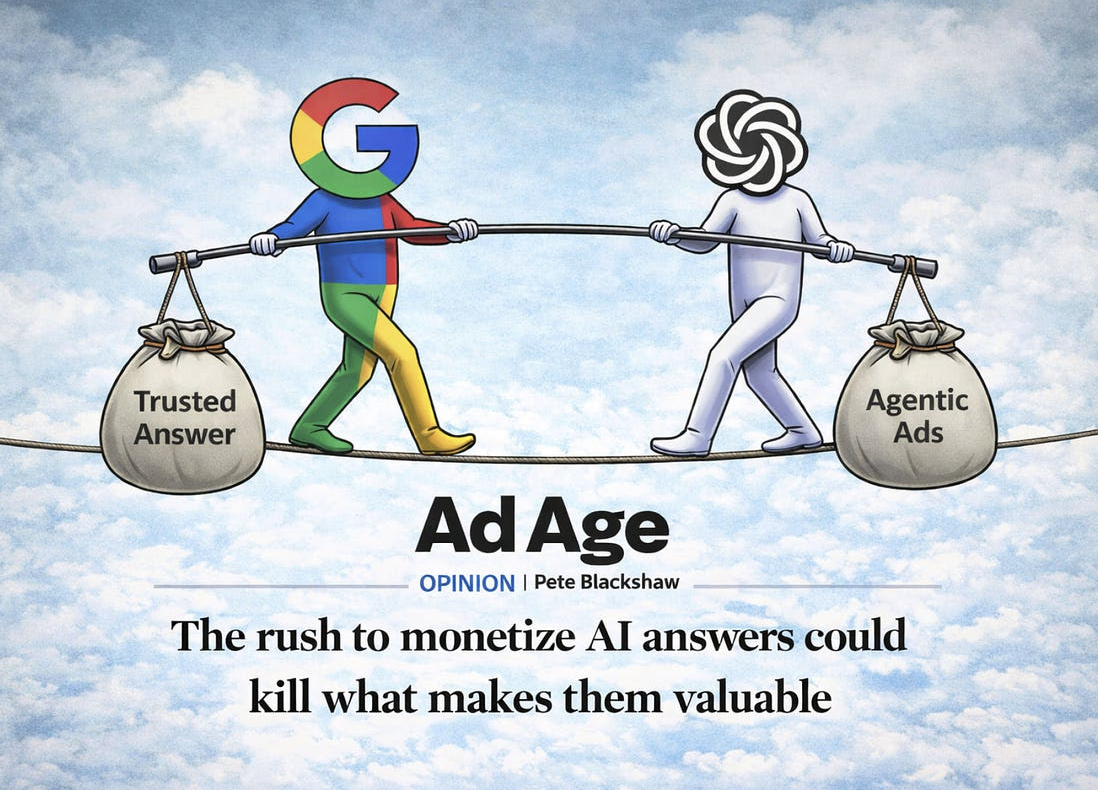
I weighed in today in Ad Age on the rush to monetize AI answers, particularly as OpenAI, Google, and Amazon roll out new ad models. Rather than repeat the column here, I’ll briefly frame the issue—and then share how the major approaches are beginning to take shape.
At the core, this isn’t a debate about whether advertising belongs in AI. A sustainable, win-win model will emerge. Platforms need revenue. Brands need access. Consumers benefit when answers connect them to relevant, useful solutions.
The key variable—especially in these early stages—is consumer receptivity.
AI answers earned trust because they felt earned, not sold. Helpful rather than interruptive. Clarifying rather than manipulative. That trust gives the industry room to experiment—but not unlimited room. Early design choices will matter disproportionately, shaping how people perceive commercial influence inside AI conversations going forward.
This makes advertising in AI less a media problem and more a design and sensitivity problem. AI answers don’t have pages or obvious ad slots. Separation, disclosure, and tone are intentional choices—and the industry will need to stay especially attuned to how those choices land with users.
There’s also a practical reality for brands: paid access doesn’t replace answer readiness. Winning in AI conversations still depends on being able to handle follow-up questions—about safety, suitability, comparisons, and tradeoffs. When brands aren’t prepared, AI systems fill the gaps on their behalf.
How the Major Models Are Taking Shape
What’s encouraging is that we’re not seeing a single, blunt monetization approach emerge. The leading platforms are experimenting along different trust and utility dimensions.
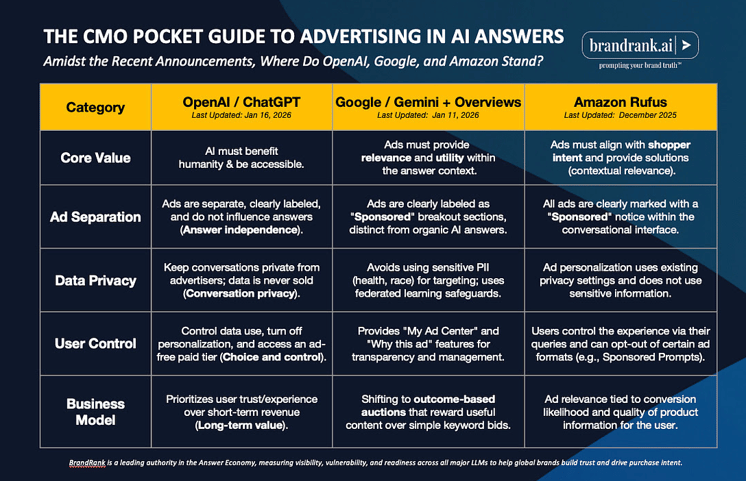
- OpenAI / ChatGPT is starting from a trust-first posture, keeping ads clearly separated and labeled, protecting conversation privacy, and giving users meaningful control—including ad-free options. It’s an approach designed to establish strong norms early.
- Google / Gemini is pursuing a balanced path, integrating sponsored content in clearly marked sections while emphasizing relevance, utility, and outcome-based performance rather than simple keyword bidding. The intent appears to be monetization that complements answers, not overwhelms them.
- Amazon / Rufus is leaning into its strength in commerce, embedding sponsored elements directly into conversational shopping flows where intent is explicit and value exchange is clear. It’s a natural extension of Amazon’s ecosystem—and a useful test case for how far conversational ads can go when tightly aligned to user goals.
The common thread: all three models recognize that trust is the currency that ultimately determines scale. Or do they?
The opportunity ahead isn’t about rushing to colonize AI answers. It’s about learning—quickly but carefully—what users welcome, what they tolerate, and what they reject. If the industry stays sensitive to consumer receptivity now, especially in these formative moments, advertising in AI can evolve into something meaningfully better than what came before.
As I wrote in Ad Age today:
“Agentic shopping will reshape commerce. But the brands that win won’t be the ones that shout loudest inside the conversation. They’ll be the ones that earn the right to be there.”