

Stanford captures 70 AI mentions while liberal arts colleges appear in only 8% of responses—revealing extreme concentration in how AI reshapes college discovery
Last Tuesday, a high school junior in Ohio typed four words into ChatGPT: "best university for engineering."
She didn't visit 15 college websites. She didn't cross-reference five ranking systems. She didn't call her guidance counselor.
She asked AI. She got an answer. She moved on.
This is happening millions of times per day. And if your university isn't in that answer, you don't exist in that moment of discovery.
At BrandRank, we've spent the last two years helping Fortune 500 brands understand what I call "The Answer Economy"—the seismic shift from search engines to answer engines. We track 200 prompts daily for brands like Nestlé, P&G, and Mars, measuring which brands win when consumers ask AI for recommendations.
Now we've turned that methodology toward higher education. What we found should trouble university marketing and admissions leaders.
We Asked 100 Questions. The Results Revealed Extreme Inequality.
Over the past month, we analyzed thousands of AI queries across 100 decision-critical college search questions—the kinds of questions that shape enrollment decisions. We queried six major AI platforms: ChatGPT, Gemini, Claude, Grok, Perplexity, and DeepSeek. We ran multiple prompts per question to identify the most common answer and average out variability.
The result: 600 validated data points that reveal which universities dominate AI-powered discovery—and which are virtually invisible.
We're calling this the University Answer Share Index (UASI), and it exposes something unprecedented: The Answer Divide.
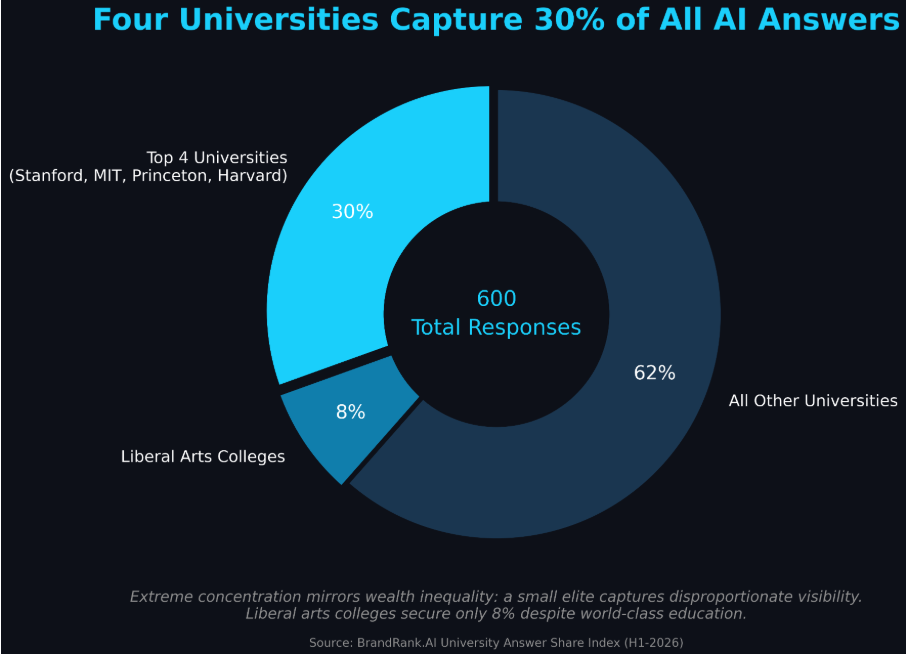
Stanford captured 70 mentions across our 600 responses. That's more than MIT and Princeton combined. Just four universities—Stanford, MIT, Princeton, and Harvard—represent 30% of all answers.
If you're a mid-tier regional university, a specialized liberal arts college, or an international institution with world-class academics, you're fighting for scraps. And most of you don't even know the battle has started.
The Nielsen Ratings of Answer Share
Just as Nielsen measured what America watched on TV, we're measuring what AI recommends. And the concentration is stark.
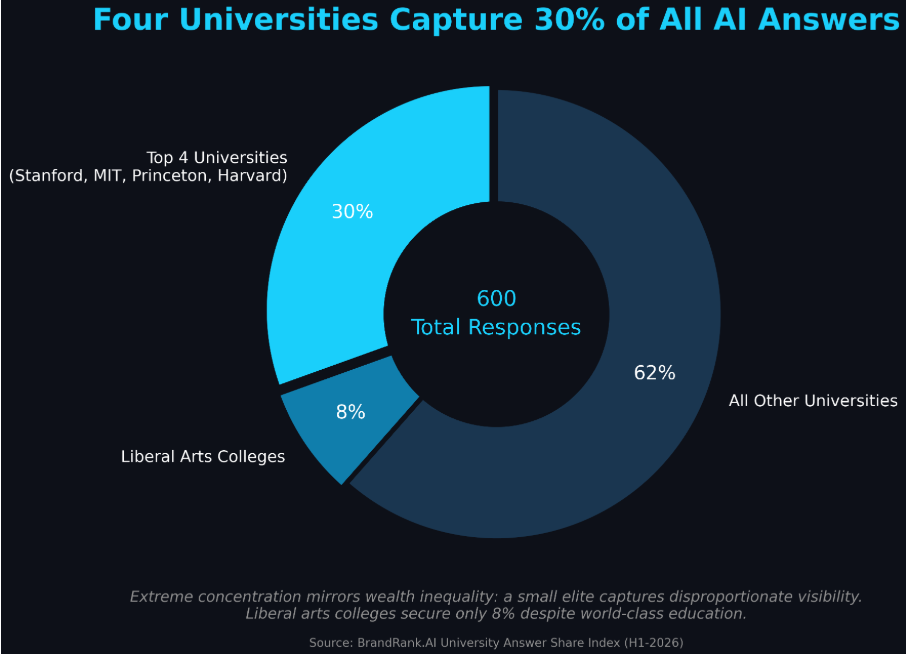
This isn't just about prestige. It's about structural advantage in how AI systems weight sources, prioritize content freshness, and rank authority. The universities that invested heavily in structured data, consistent digital presence, and authoritative backlinks are winning. Those that buried their stories in ivory tower publications and alumni newsletters are invisible.
Each AI Platform Has a "Personality"
Here's where it gets interesting. Not all AI platforms think alike.
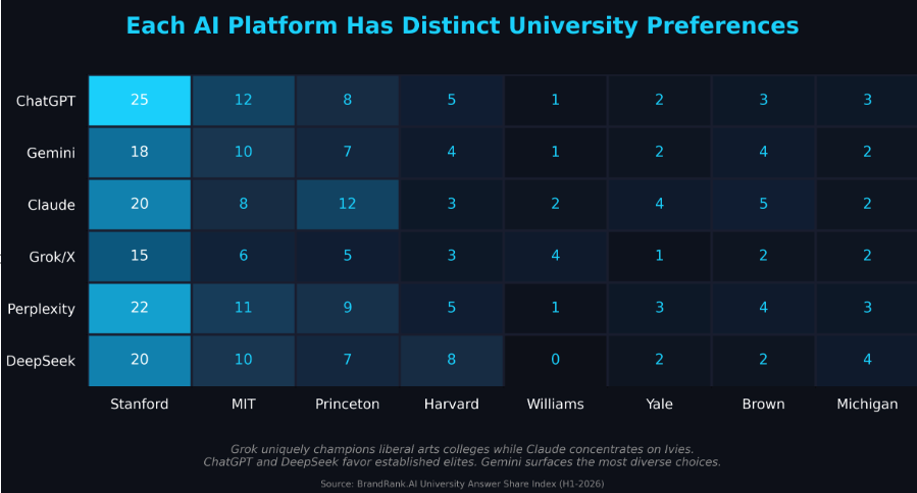
ChatGPT and DeepSeek lean heavily toward established elites—Stanford, MIT, Harvard dominate their responses with remarkable consistency.
Claude shows the most conservative pattern, concentrating heavily on Ivy League institutions. When Claude answers questions about undergraduate teaching or academic quality, Princeton appears with striking frequency.
Grok stands alone. It uniquely champions liberal arts colleges—Williams, Swarthmore, and Amherst appear far more often than on other platforms. If you're a liberal arts institution, Grok is your friend. Everywhere else, you're struggling.
Gemini surfaces the most diverse choices, including teaching-focused institutions like Elon University and Georgia State that rarely appear elsewhere. This suggests Gemini's sourcing algorithms look beyond traditional prestige metrics.
Perplexity, true to its citation-driven model, balances research universities with teaching-focused institutions and often surfaces mid-tier universities with strong specific programs.
For universities, this means you can't optimize for "AI" as a monolithic entity. You need platform-specific strategies. What works for ChatGPT won't work for Grok. The game has fundamentally changed.
Different Universities "Own" Different Topics
Here's the strategic insight: certain universities have become synonymous with specific categories in AI responses.
[INSERT CHART 4: Universities Dominate Different Strategic Categories]
Ask about academic rigor, and AI consistently recommends the University of Chicago. Ask about teaching quality, you'll hear Princeton. STEM excellence? MIT owns that conversation. Innovation and entrepreneurship? Stanford dominates. Trust and values? Notre Dame leads.
This is "category ownership" in the Answer Economy. Just as Kleenex owns "tissue" and Xerox once owned "copying," these universities own their categories in AI's collective knowledge base.
The question for every other university: What category do you own? If the answer is "none," you have a visibility crisis.
Geography is Destiny in the Answer Economy
The Answer Divide isn't just institutional—it's geographic.
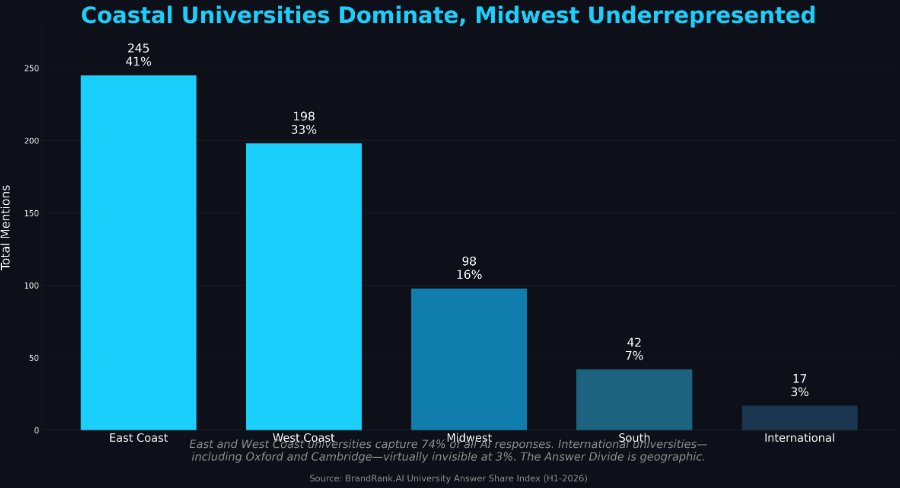
East and West Coast universities capture 74% of all AI responses. Midwest institutions collectively secure just 16%. The South manages 7%.
And international universities? Nearly invisible. Oxford and Cambridge—institutions with centuries of academic excellence—appear in only 3% of responses.
This isn't about academic merit. It's about digital presence, content structure, and how AI training data reflects American institutional dominance. US universities invest heavily in digital infrastructure and structured content that AI engines can parse effectively. International institutions, despite world-class reputations, haven't optimized for AI discovery.
The University of Michigan (19 mentions) stands as the strongest Midwest performer, but even Michigan trails Stanford by a 4:1 ratio. Northwestern (7 mentions), Ohio State (6 mentions), and Notre Dame (11 mentions) fight for visibility while coastal peers dominate.
Liberal Arts Colleges Face an Existential Crisis
This is where the data becomes most troubling.
Liberal arts colleges—institutions built on close faculty relationships, intellectual rigor, and transformative undergraduate education—appear in only 8% of responses.
Williams College leads with 11 mentions. That's the best performance among liberal arts institutions. Amherst and Swarthmore manage 6 each. Harvey Mudd, despite world-class STEM outcomes, captures just 5.
Compare that to Stanford's 70, MIT's 45, or even Michigan's 19, and the scale of the challenge becomes clear. When prospective students ask AI about "best undergraduate teaching" or "colleges with close faculty mentoring"—the exact strengths of liberal arts education—these institutions should dominate. They don't.
Why? Because AI platforms can't measure what makes liberal arts colleges special. They can measure research output, institutional scale, and web presence. They struggle with personalized attention, transformative teaching, and intellectual community.
Unless liberal arts colleges fundamentally restructure how they present themselves to AI systems, they'll continue losing students who never knew these institutions existed.
What This Means for University Leaders
The admission funnel has been restructured by AI, and it happened while you were optimizing for U.S. News rankings.
That parent in California won't visit your website. That guidance counselor won't dig through your departmental PDFs. That professor advising a doctoral student won't cross-reference your graduate programs.
They'll ask AI. And if you're not in the answer, you've lost them.
This isn't hypothetical. We're watching it happen in real-time with consumer brands. Three years ago, brands obsessed over SEO rankings. Today, they're asking us: "What does ChatGPT say about our product?" Because that's where purchase decisions happen now.
Universities are five years behind this curve. Most don't track their Answer Share. They don't know which questions about their institution AI gets wrong—or doesn't answer at all. They're running 20th-century marketing strategies in an Answer Economy.
The Path Forward
Here's what needs to change:
1. Measure your Answer Share. You can't manage what you don't measure. Universities need systematic tracking of how AI platforms represent them across decision-critical questions.
2. Optimize for Answer Engines, not search engines. This means structured data, semantic consistency across web properties, authoritative backlinks, and content that AI systems can parse and cite.
3. Understand platform personalities. Different AI platforms have different biases. Your content strategy needs to account for this variation.
4. Own a category. You can't win on everything. What's your distinctive strength? Make sure AI knows it.
5. Stop hiding achievements. If your groundbreaking research, innovative programs, and transformational outcomes live only in alumni magazines and faculty newsletters (or Ivory Towers), AI will never find them.
The institutions that understand this first—and optimize their Answer Engine presence accordingly—will capture the next generation of students. Those that don't will wonder why their yield rates declined and their inquiry pipeline dried up.
Why We Built the UASI
We're releasing the University Answer Share Index bi-annually because this problem will only accelerate. AI adoption among prospective students is growing exponentially. The platforms are refining their algorithms. The stakes are rising.
Universities deserve the same visibility into AI performance that Fortune 500 brands receive. They need to understand their Answer Share, identify vulnerability gaps, and optimize their content readiness.
Just as Nielsen measured what America watched, we're measuring what AI recommends. Because in the Answer Economy, visibility is everything.
And right now, most universities are invisible.
About the Study: The University Answer Share Index (UASI) analyzed thousands of AI queries across 100 decision-critical college search questions spanning seven categories: Academic Quality & Teaching, Specific Programs, Campus Life, Career Outcomes, Diversity & Values, Financial Considerations, and Trust & Reputation. Each question was run multiple times across six platforms (ChatGPT, Gemini, Claude, Grok, Perplexity, and DeepSeek) to identify the most common answer and reduce variability. The complete interactive scorecard is available at BrandRank.AI.
Contact: Pete Blackshaw, CEO & Co-Founder, BrandRank.AI | pete@brandrank.ai


