
Over the past two years I've been writing extensively about the "The Answer Economy" — including recent pieces in AdAge on the Walmart-OpenAI partnership and how AI systems are fundamentally reshaping brand portrayal. But here's what's keeping me up at night: The biggest decision in advertising history is being made right now—not by CMOs or brand leaders, but by AI platform CEOs
The question isn't if advertising will come to AI answers. It's which model wins—and whether brands understand that advertising is no longer something that sits around the experience. It's increasingly part of the answer itself.
That's why I'm hosting "Advertising in AI Answers: The New Rules of Trust, Influence, and Design" this Tuesday, February 10th at 1:00pm ET. The brands we work with at BrandRank keep asking the same question: Should we advertise in AI answers? And I realized the answer isn't yes or no—it's which platforms, under what conditions, and only if you understand what you're actually voting for.
The Trust Architecture Problem
Anthropic just ran Super Bowl ads positioning Claude as the "trustworthy AI" with zero advertising in answers. OpenAI is racing toward a $150 billion valuation that will demand monetization. Google is already aggressively monetizing AI Overviews. Amazon Rufus has made the product recommendation the ad.
But here's what changes everything: At BrandRank.AI, we constantly poll and query answer engines about advertising receptivity. Across thousands of queries, we've learned that each platform operates on a fundamentally different trust architecture—what I'm calling their "trust DNA."
- ChatGPT functions as a "Regulatory Framework Advocate"—listing 11 off-limits advertising categories versus competitors' 3-6, emphasizing compliance and audit trails.
- Claude operates as an "Ethical Balance Seeker"—prioritizing editorial independence and becoming the only engine to honestly admit "no clear industry leader" exists on AI advertising trust.
- Gemini serves as a "Human Authenticity Guardian"—most concerned with deepfakes and impersonation.
This isn't academic. What builds trust on ChatGPT—compliance frameworks and measurable metrics—may be completely ineffective on Claude, where values alignment signals credibility. Generic "AI optimization" is dead.
Why Ad Separation Is the Defining Issue
This is what I keep coming back to with every Fortune 500 CMO I talk to: the rules that governed every previous advertising medium don't apply when:
- Conversational UI eliminates visual boundaries between organic and sponsored
- The AI's credibility transfers directly to your brand (and its mistakes become yours)
- You can't advertise your way out of bad organic answers
- Each platform evaluates trustworthiness through a completely different ethical lens
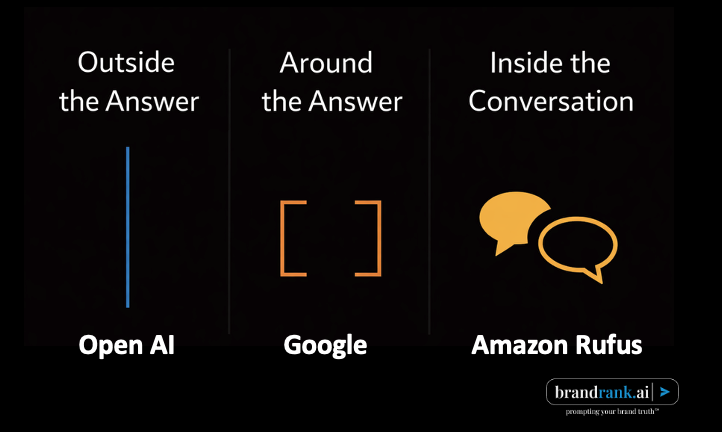
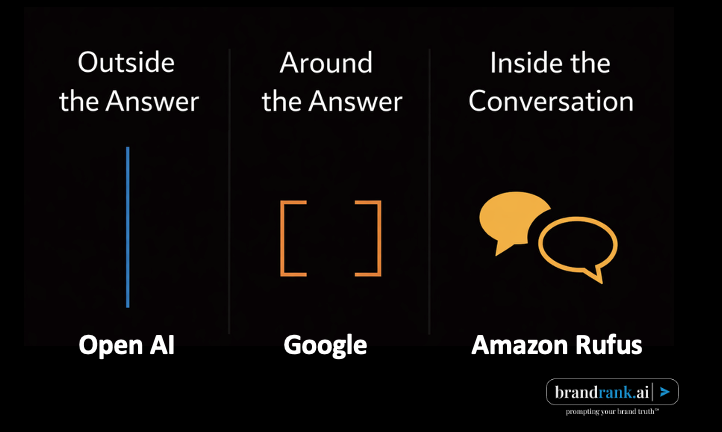
The defining question: Will advertising be outside the answer, around the answer, or inside the conversation itself? Or none at all, as Claude is loudly suggesting (ironically) in Super Bowl spots.
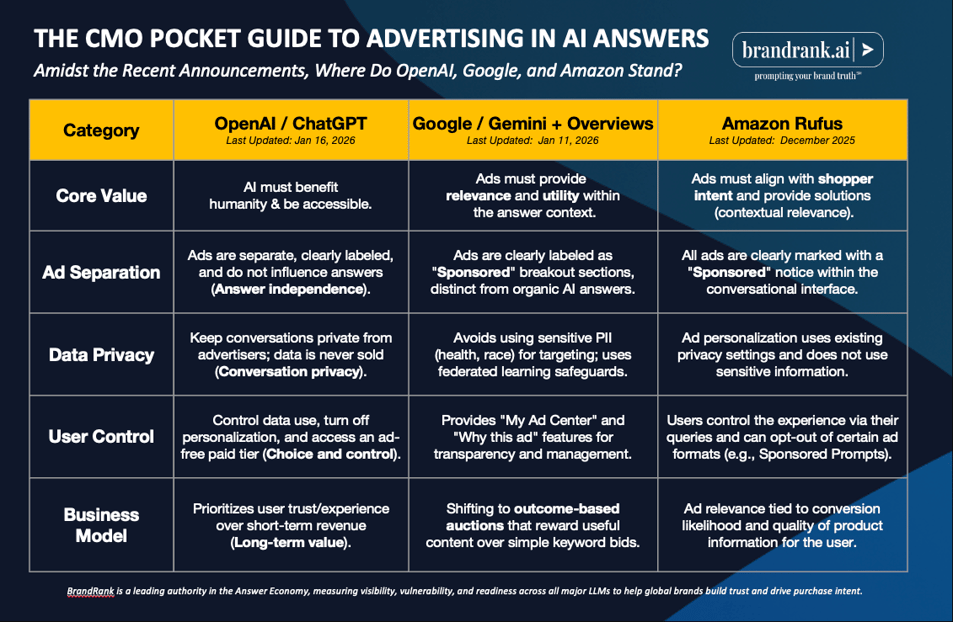
OpenAI is positioning for ads outside the answer—separate, clearly labeled, preserving answer independence.
Google places ads around the answer—"Sponsored" breakout sections distinct from AI Overviews but contextually adjacent.
Amazon Rufus embeds ads inside the conversation—"Sponsored" notices woven into the conversational interface where the recommendation itself becomes the ad.
Each model creates a fundamentally different trust contract. Each has different implications for user control, data privacy, and business sustainability. And most brands haven't assessed which model aligns with how they signal credibility—before these platforms start taking their money.
How Do You Get Started?
Most brand leaders I talk to know they need to do something—they just don't know what. The answer depends on three things you can't guess:
- Where do you actually appear across AI platforms right now—and what are they saying about you?
- Where are your vulnerabilities—factual errors, competitor dominance, negative framing that paid advertising will only amplify?
- Which platform's ad separation model and trust DNA align with how your brand signals credibility?
You can't make smart advertising decisions without knowing your organic baseline AND understanding each platform's trust architecture. That's exactly what we measure for 60+ Fortune 500 clients—AI Visibility, Brand Vulnerability, and Content Readiness across all major platforms.
The brands winning in the Answer Economy aren't those with the most content or highest SEO rankings. They're brands that understand how each platform defines trustworthiness—and can speak the ethical language each system recognizes.
Join Me Tuesday
If you're trying to figure out whether and how to navigate advertising in AI answers—or convincing your leadership team this requires a fundamentally different approach—I hope you'll join me.
I'll walk through the complete ad separation framework, share the trust DNA research showing how each platform evaluates credibility differently, and give you the practical tools you can use immediately to assess which platforms match your brand's readiness.
This isn't about tactics. It's about understanding trust, influence, and design in an environment where advertising becomes part of the answer itself.
[Register: "Advertising in AI Answers: The New Rules of Trust, Influence, and Design" - Tuesday, February 10th, 1:00pm ET]
—Pete


