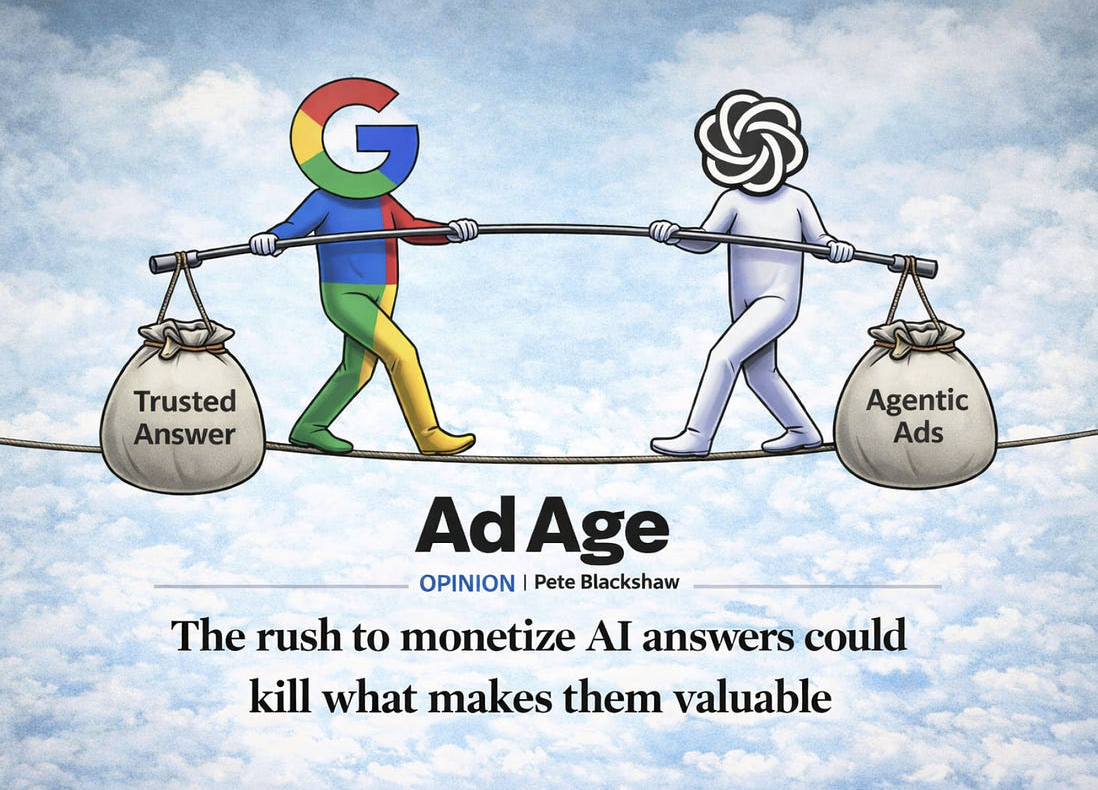
This week marked a real inflection point for advertising!
Within days of each other:
-
OpenAI detailed how ads will begin appearing in ChatGPT, emphasizing that ads will be clearly labeled, separate from answers, and not influence the answer itself.
-
Google expanded how ads and offers can surface inside AI-powered experiences like AI Mode and AI Overviews, framing them as utility-driven additions at moments of clear commercial intent.
-
And it’s worth remembering that Amazon moved first, introducing “Promoted Prompts” back in December, allowing sponsored prompts to shape the starting point of a conversational shopping journey.
All of this is still very new. But taken together, it signals a clear shift: advertising is now officially part of AI answers.
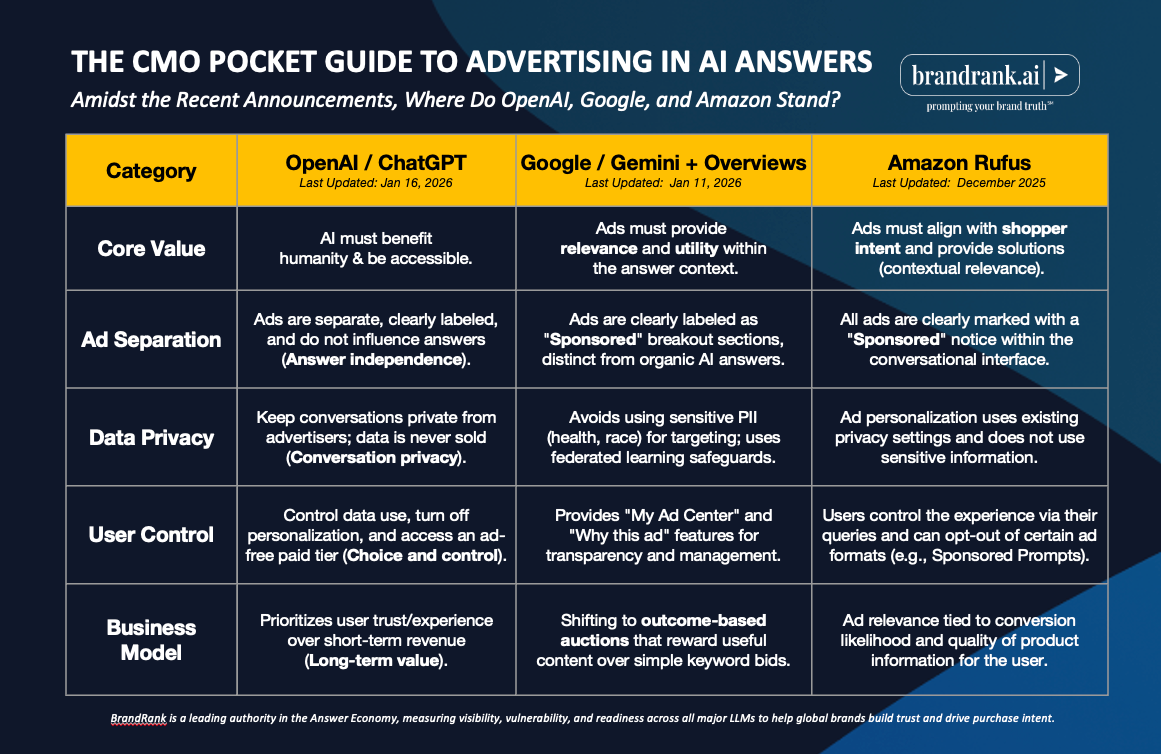
The key comparison: ad separation
It’s how each platform defines and enforces ad separation.
-
OpenAI / ChatGPT
Ads are separate, clearly labeled, and explicitly do not influence answers — what OpenAI has described as answer independence. -
Google / Gemini + AI Overviews
Ads appear in clearly labeled “Sponsored” breakout sections, visually distinct from organic AI answers and generally aligned to high-intent, decision-ready contexts. -
Amazon Rufus
Ads are embedded within the conversational interface — including Promoted Prompts — labeled as sponsored but more tightly woven into the interaction itself.
Same direction. Very different implementations.
Why this distinction matters
no links page, no fixed ad units, no obvious handoff between “content” and “commercial.”
As a result, separation becomes a design decision, not just a placement rule.
-
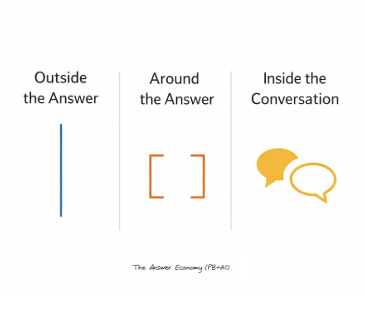
OpenAI separates ads from answers.
-
Google separates ads around answers.
-
Amazon integrates ads within the conversational flow.
That difference may seem subtle now, but it shapes how users interpret intent, relevance, and credibility — and it’s something CMOs should understand early, before optimization, scale, and performance pressure take over the conversation.